
Ashoka Tree Resort Ubud: Strategic Business & Revenue Development Plan 2026–2028
Feasibility Study30 min read

Ashoka Tree Resort Ubud: Strategic Business & Revenue Development Plan 2026–2028

Triproom.id's full strategic business, revenue development, and financial performance plan for Ashoka Tree Resort Ubud — covering market positioning, financial projections, room category performance, ancillary revenue strategy, risk mitigation, and a structured collaboration framework for 2026–2028.

Ashoka Tree Resort Ubud is a 44-key boutique jungle retreat positioned at the intersection of romantic hospitality, wellness travel, and authentic Balinese experience. This Strategic Business & Revenue Development Plan 2026–2028, prepared by Triproom.id | PT. Jam Asia Property, outlines a disciplined path from OTA-dependent volume operator to a direct-booking, experience-led destination brand with IDR 25.53 Billion in projected 3-year revenue.

44 KeysBoutique Jungle Retreat
IDR 25.53B3-Year Projected Revenue
IDR 8.29BYear 1 Gross Revenue
38.4%RevPAR Growth (3-Year)
24%Year 1 EBITDA Margin
35.3%Year 1 GOP Margin

The Landscape Has Changed

Bali is no longer a single, homogeneous hospitality market. Pockets of genuine excellence now coexist alongside undifferentiated supply fighting on price alone. The properties winning today are not necessarily the largest — they are the most precisely positioned, the most emotionally resonant, and the most operationally disciplined.

Maximize keys. Drive occupancy. Compete on OTA rate. Hope the market lifts all boats.Hospitality success today depends on positioning, branding, guest experience, pricing power, and risk-adjusted revenue growth. Occupancy growth alone is no longer enough.
Market Reality

Growth alone is not enough. In today's Bali market, the properties that survive on volume alone will be crowded out by those that compete on meaning.

The Bali Hospitality Market Shift
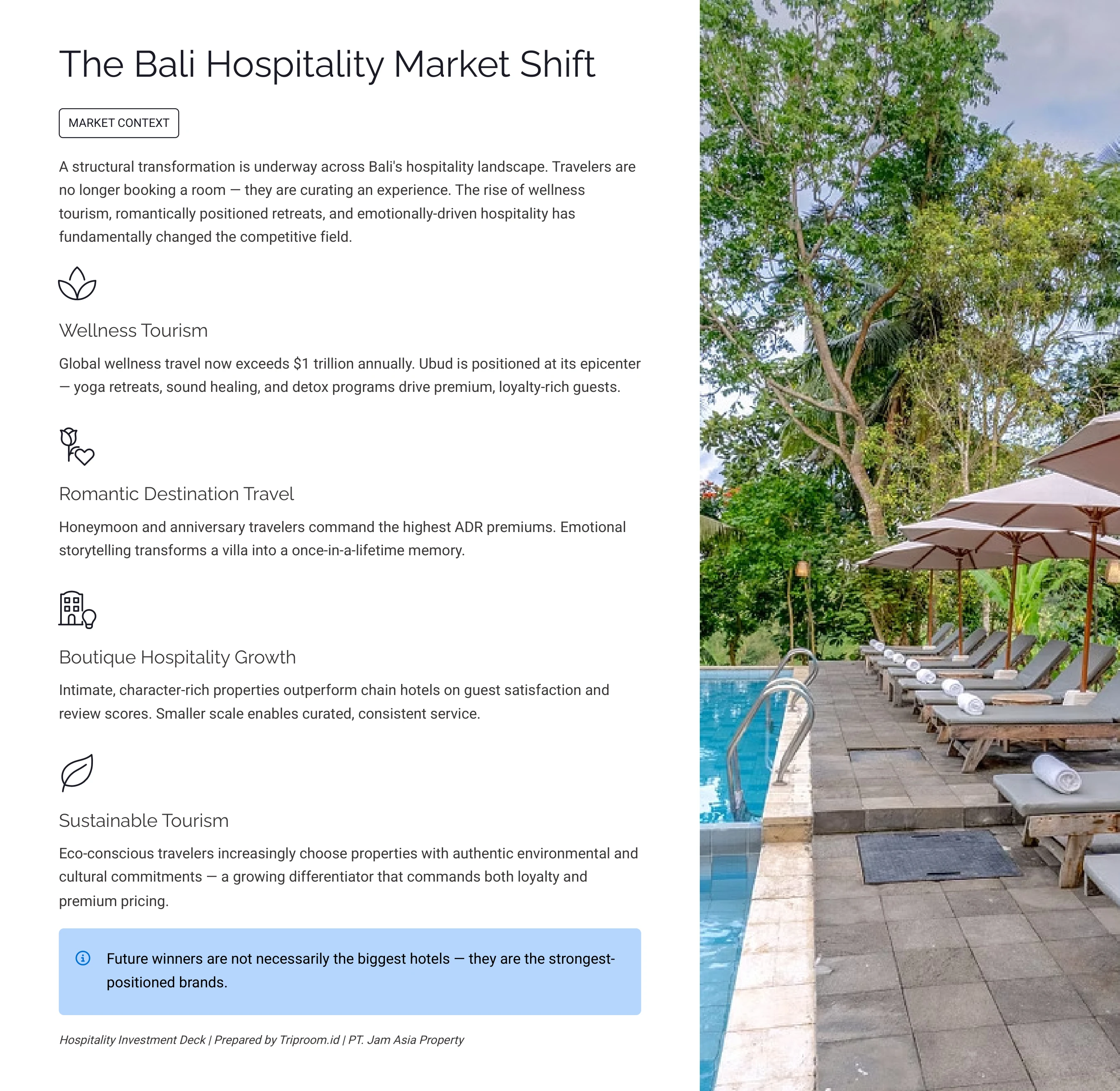
Ashoka Tree Resort Ubud — Bali Hospitality Market Shift: Wellness, Romantic, Boutique, Sustainable Tourism

A structural transformation is underway across Bali's hospitality landscape. Travelers are no longer booking a room — they are curating an experience. The rise of wellness tourism, romantically positioned retreats, and emotionally-driven hospitality has fundamentally changed the competitive field.

Wellness TourismGlobal wellness travel now exceeds $1 trillion annually. Ubud is positioned at its epicenter — yoga retreats, sound healing, and detox programs drive premium, loyalty-rich guests.
Romantic Destination TravelHoneymoon and anniversary travelers command the highest ADR premiums. Emotional storytelling transforms a villa into a once-in-a-lifetime memory.
Boutique Hospitality GrowthIntimate, character-rich properties outperform chain hotels on guest satisfaction and review scores. Smaller scale enables curated, consistent service.
Sustainable TourismEco-conscious travelers increasingly choose properties with authentic environmental and cultural commitments — a growing differentiator that commands both loyalty and premium pricing.
Market Insight

Future winners are not necessarily the biggest hotels — they are the strongest-positioned brands.

Why Ubud Remains a Compelling Market

Wellness tourism demand growing year-over-yearIncreasing supply from undifferentiated boutique properties
Ubud firmly established as Bali's premier honeymoon destinationInfrastructure pressure limiting peak season capacity
Jungle retreat segment showing consistent long-stay demandRising land and development costs compressing margins
Rise of slow travel and remote-work-extended staysOTA pricing pressure eroding direct rate integrity
Boutique resort trend replacing mass-market preference
Experiential tourism replacing transactional accommodation
Strategic Imperative

Competition is intensifying. Positioning clarity is no longer optional — it is the primary defense.

Ashoka Tree Resort: Brand Positioning
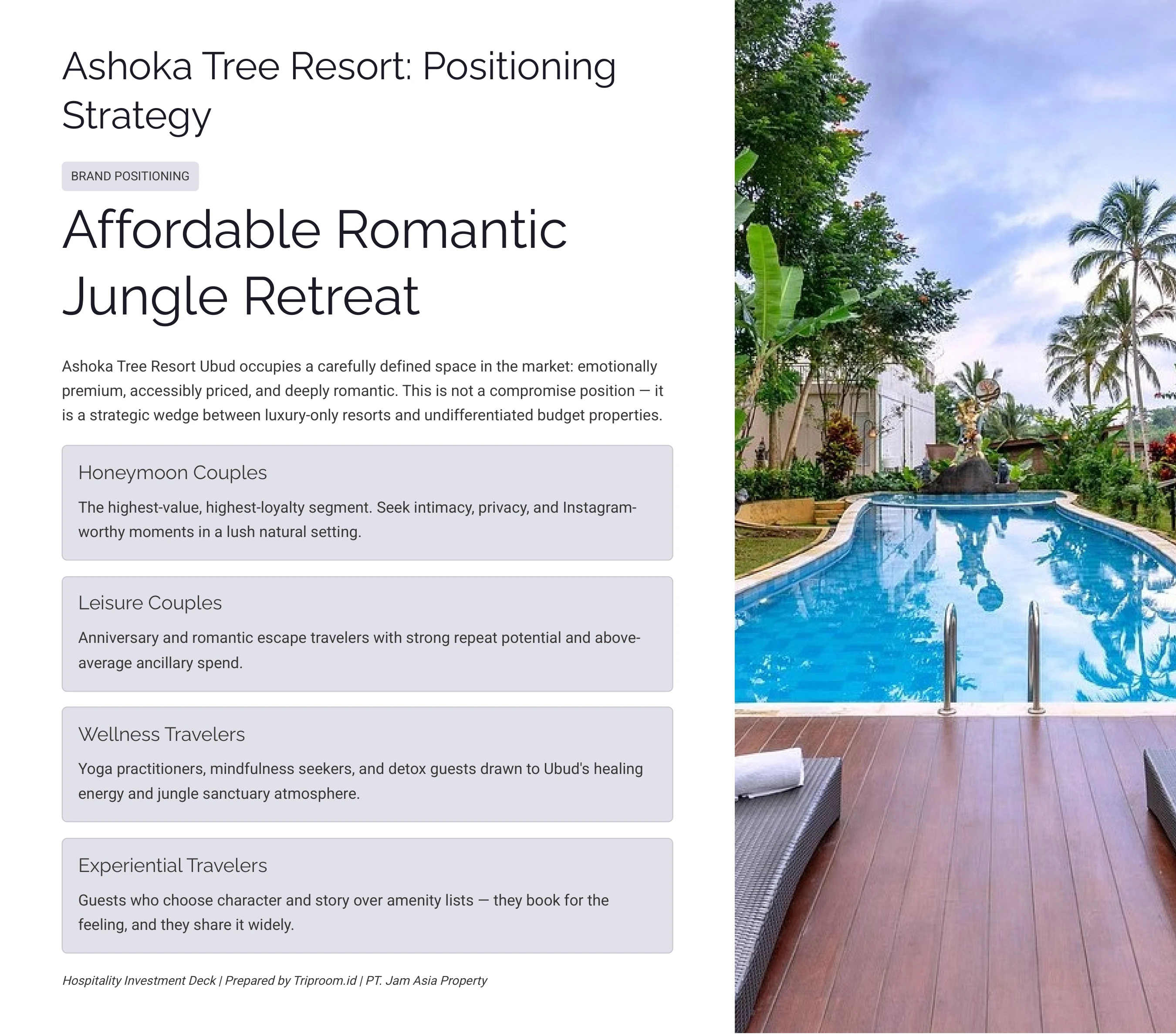
Ashoka Tree Resort Ubud — Brand Positioning: Affordable Romantic Jungle Retreat

Ashoka Tree Resort Ubud occupies a carefully defined space in the market: emotionally premium, accessibly priced, and deeply romantic. This is not a compromise position — it is a strategic wedge between luxury-only resorts and undifferentiated budget properties.

Honeymoon CouplesThe highest-value, highest-loyalty segment. Seek intimacy, privacy, and Instagram-worthy moments in a lush natural setting.
Leisure CouplesAnniversary and romantic escape travelers with strong repeat potential and above-average ancillary spend.
Wellness TravelersYoga practitioners, mindfulness seekers, and detox guests drawn to Ubud's healing energy and jungle sanctuary atmosphere.
Experiential TravelersGuests who choose character and story over amenity lists — they book for the feeling, and they share it widely.

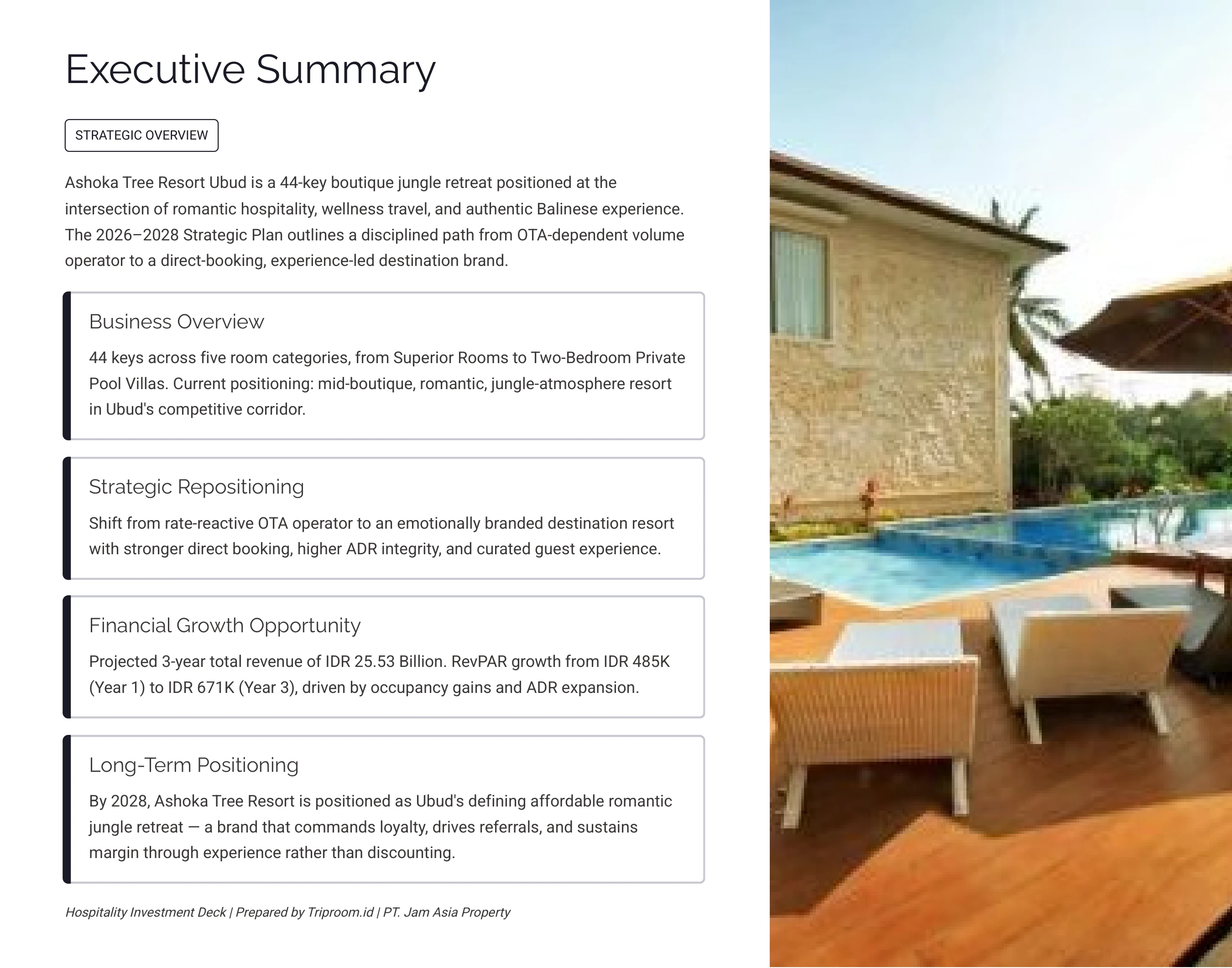
Executive Summary

Ashoka Tree Resort Ubud — Executive Summary: Strategic Overview 2026–2028
44 Keys5 Room Categories
IDR 25.53B3-Year Total Revenue
IDR 671KYear 3 RevPAR Target
38.4%RevPAR Growth 3-Year
Business Overview44 keys across five room categories, from Superior Rooms to Two-Bedroom Private Pool Villas. Current positioning: mid-boutique, romantic, jungle-atmosphere resort in Ubud's competitive corridor.
Strategic RepositioningShift from rate-reactive OTA operator to an emotionally branded destination resort with stronger direct booking, higher ADR integrity, and curated guest experience.
Financial Growth OpportunityProjected 3-year total revenue of IDR 25.53 Billion. RevPAR growth from IDR 485K (Year 1) to IDR 671K (Year 3), driven by occupancy gains and ADR expansion.
Long-Term PositioningBy 2028, Ashoka Tree Resort is positioned as Ubud's defining affordable romantic jungle retreat — a brand that commands loyalty, drives referrals, and sustains margin through experience rather than discounting.

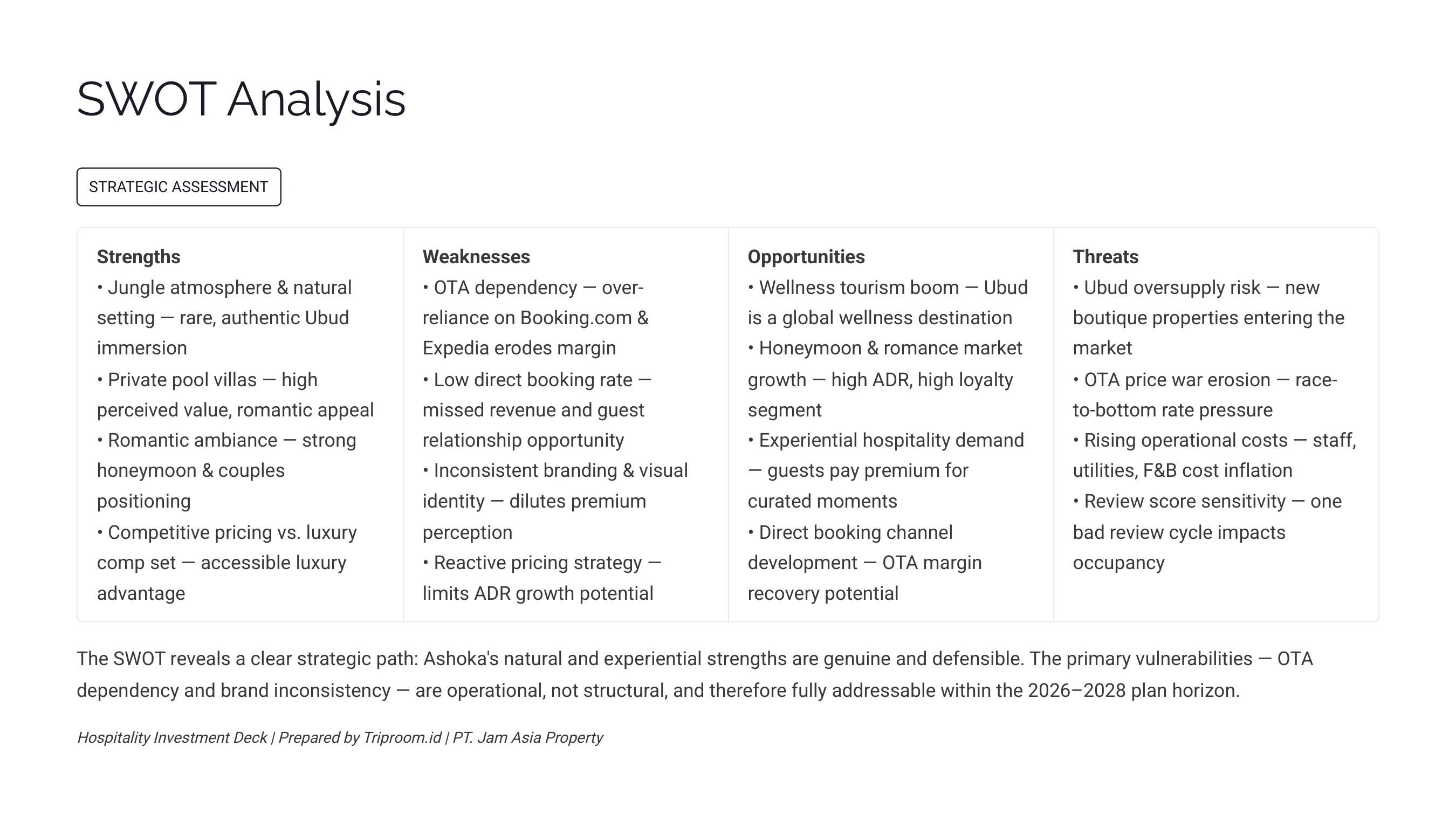
SWOT Analysis

Ashoka Tree Resort Ubud — SWOT Analysis: Strengths, Weaknesses, Opportunities, Threats
StrengthsJungle atmosphere & natural setting — rare, authentic Ubud immersion. Private pool villas — high perceived value, romantic appeal. Romantic ambiance — strong honeymoon & couples positioning. Competitive pricing vs. luxury comp set — accessible luxury advantage.
WeaknessesOTA dependency — over-reliance on Booking.com & Expedia erodes margin. Low direct booking rate — missed revenue and guest relationship opportunity. Inconsistent branding & visual identity — dilutes premium perception. Reactive pricing strategy — limits ADR growth potential.
OpportunitiesWellness tourism boom — Ubud is a global wellness destination. Honeymoon & romance market growth — high ADR, high loyalty segment. Experiential hospitality demand — guests pay premium for curated moments. Direct booking channel development — OTA margin recovery potential.
ThreatsUbud oversupply risk — new boutique properties entering the market. OTA price war erosion — race-to-bottom rate pressure. Rising operational costs — staff, utilities, F&B cost inflation. Review score sensitivity — one bad review cycle impacts occupancy.

The SWOT reveals a clear strategic path: Ashoka's natural and experiential strengths are genuine and defensible. The primary vulnerabilities — OTA dependency and brand inconsistency — are operational, not structural, and therefore fully addressable within the 2026–2028 plan horizon.

Market Segmentation
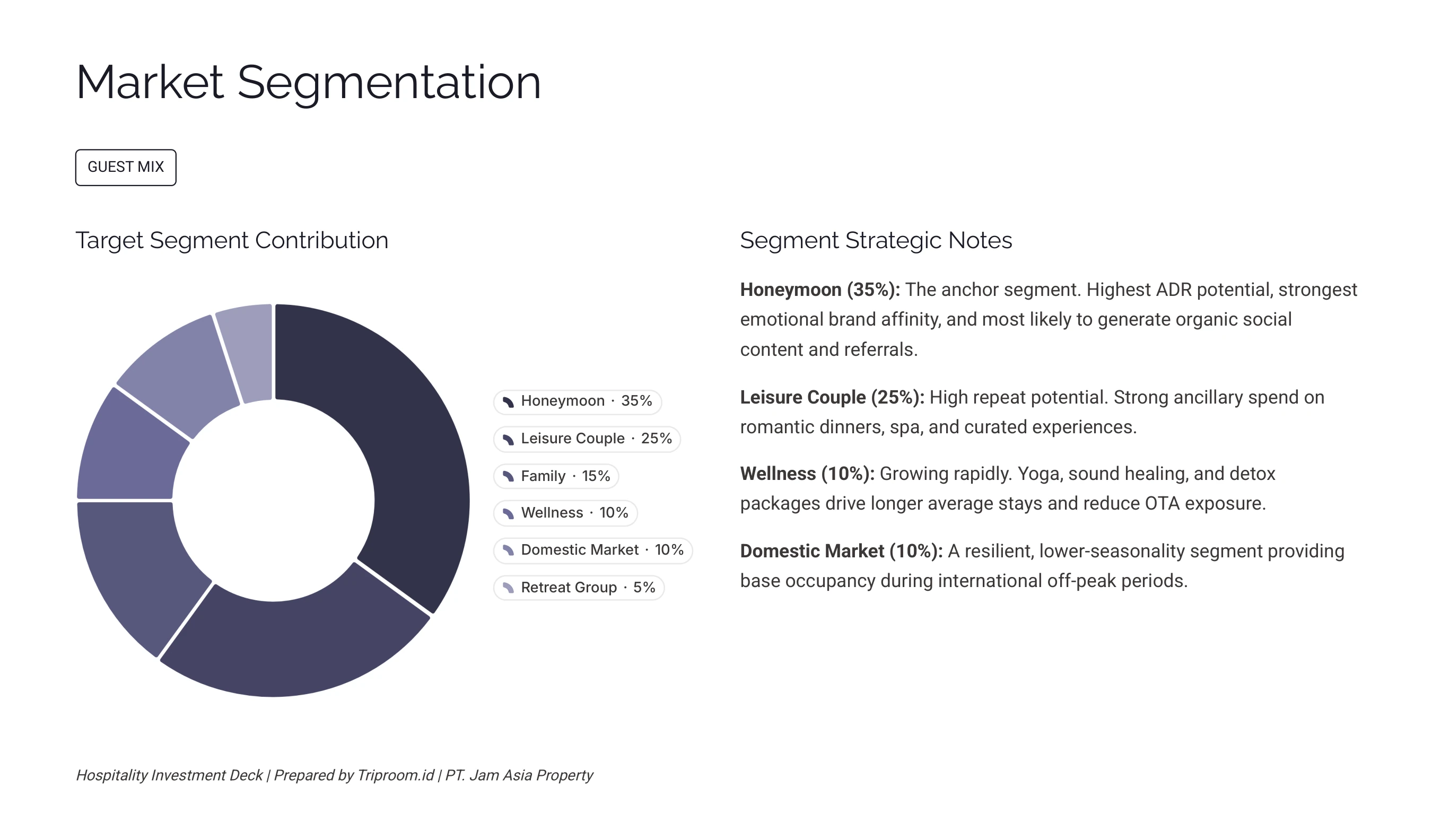
Ashoka Tree Resort Ubud — Guest Mix & Market Segmentation: Honeymoon, Leisure Couple, Family, Wellness
SegmentHoneymoon
Share35%
Strategic NotesThe anchor segment. Highest ADR potential, strongest emotional brand affinity, and most likely to generate organic social content and referrals.
SegmentLeisure Couple
Share25%
Strategic NotesHigh repeat potential. Strong ancillary spend on romantic dinners, spa, and curated experiences.
SegmentFamily
Share15%
Strategic NotesSecondary segment providing volume during school holiday windows.
SegmentWellness
Share10%
Strategic NotesGrowing rapidly. Yoga, sound healing, and detox packages drive longer average stays and reduce OTA exposure.
SegmentDomestic Market
Share10%
Strategic NotesA resilient, lower-seasonality segment providing base occupancy during international off-peak periods.
SegmentRetreat Group
Share5%
Strategic NotesGroup bookings for wellness retreats and corporate wellness programs.

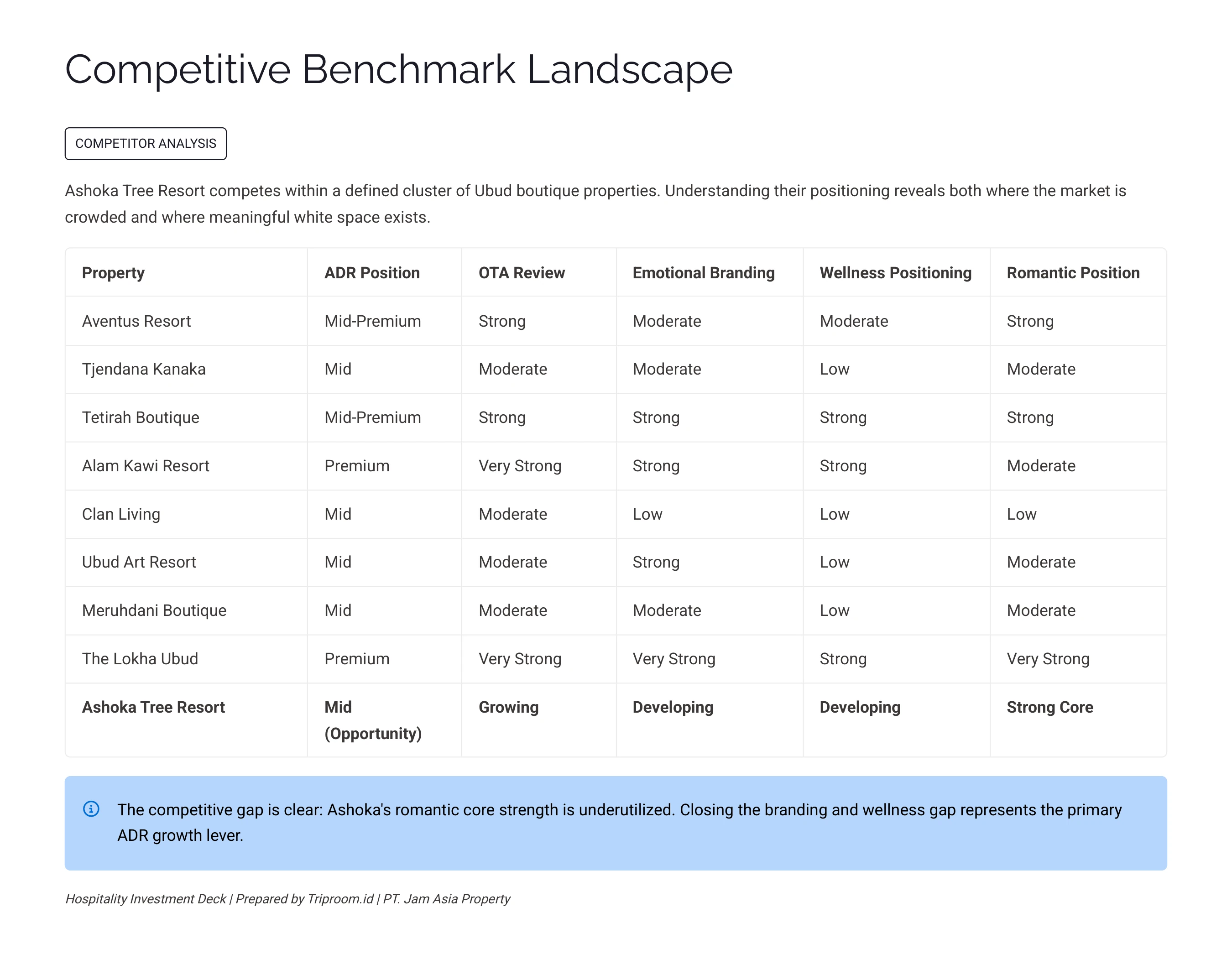
Competitive Benchmark Landscape

Ashoka Tree Resort Ubud — Competitive Benchmark Landscape: Ubud Boutique Properties Comparison

Ashoka Tree Resort competes within a defined cluster of Ubud boutique properties. Understanding their positioning reveals both where the market is crowded and where meaningful white space exists.

PropertyAventus Resort
ADR PositionMid-Premium
OTA ReviewStrong
Emotional BrandingModerate
Wellness PositioningModerate
Romantic PositionStrong
PropertyTjendana Kanaka
ADR PositionMid
OTA ReviewModerate
Emotional BrandingModerate
Wellness PositioningLow
Romantic PositionModerate
PropertyTetirah Boutique
ADR PositionMid-Premium
OTA ReviewStrong
Emotional BrandingStrong
Wellness PositioningStrong
Romantic PositionStrong
PropertyAlam Kawi Resort
ADR PositionPremium
OTA ReviewVery Strong
Emotional BrandingStrong
Wellness PositioningStrong
Romantic PositionModerate
PropertyClan Living
ADR PositionMid
OTA ReviewModerate
Emotional BrandingLow
Wellness PositioningLow
Romantic PositionLow
Competitive Gap

Ashoka's romantic core strength is underutilized. Closing the branding and wellness gap represents the primary ADR growth lever.

Strategic Market Insights

The boutique hospitality competitive advantage has fundamentally shifted. Rate parity tools have commoditized pricing transparency — the new moat is emotional differentiation.

1. Emotional StorytellingGuests book with their hearts, justify with logic. Properties that tell a compelling, authentic story convert at higher rates and command loyalty that resists competitor price comparison.
2. Visual Branding & Social ExposureInstagram-worthy moments — floating breakfasts, jungle pool villas, flower-strewn baths — function as organic marketing assets that generate bookings at zero acquisition cost.
3. Wellness IntegrationProperties with credible wellness programming attract a guest profile with higher ADR tolerance, longer stays, and stronger brand affinity. Wellness converts browsers into loyalists.
4. Guest Experience as Pricing PowerProperties with stronger emotional branding consistently command a +15–30% ADR premium versus comparable undifferentiated competitors in the same market.

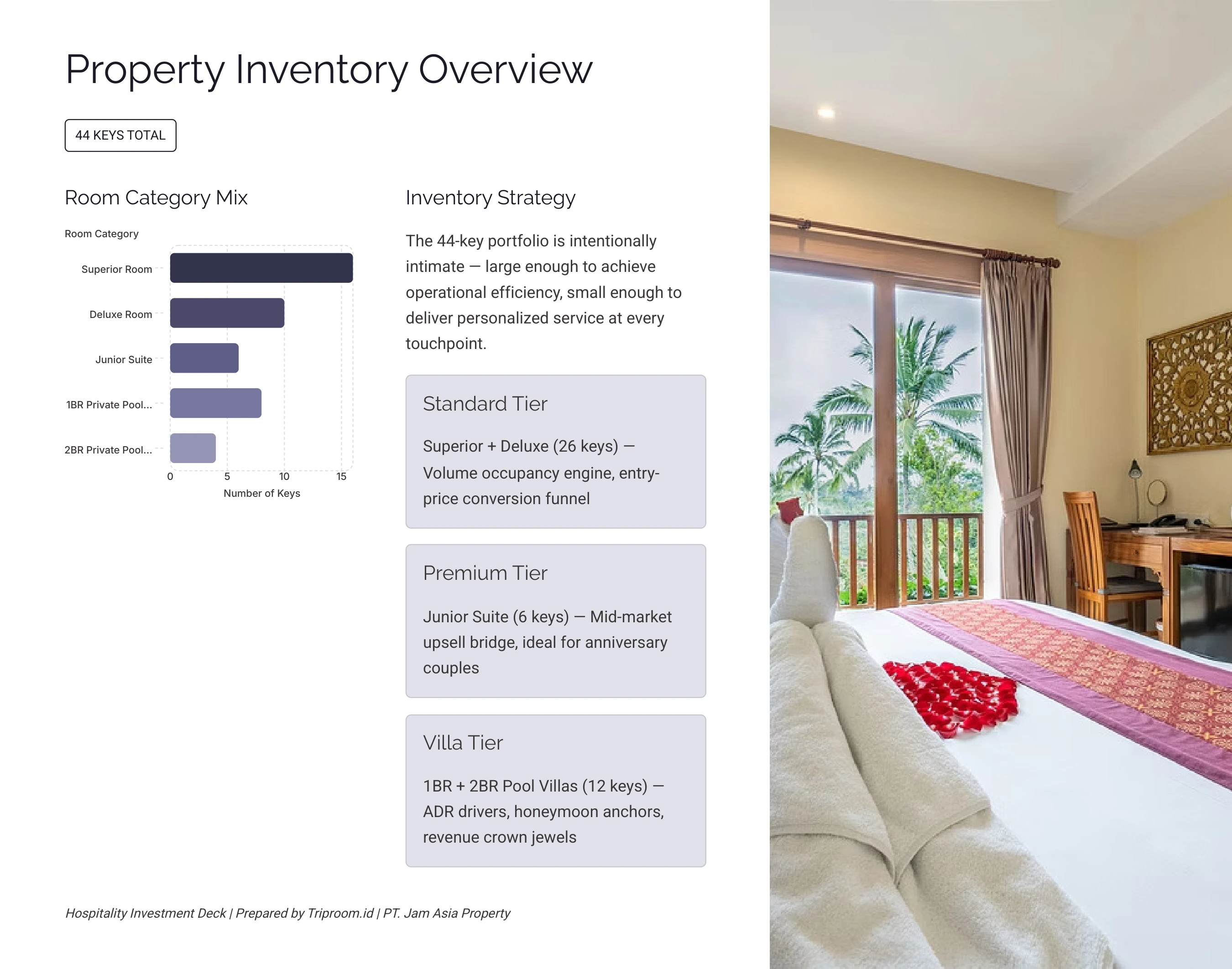
Property Inventory Overview — 44 Keys

Ashoka Tree Resort Ubud — Property Inventory Overview: 44 Keys Room Category Mix
TierStandard Tier
CategorySuperior Room
Keys16
RoleVolume occupancy engine, entry-price conversion funnel
TierStandard Tier
CategoryDeluxe Room
Keys10
RoleMid-volume, moderate ADR — occupancy stabilizer
TierPremium Tier
CategoryJunior Suite
Keys6
RoleMid-market upsell bridge, ideal for anniversary couples
TierVilla Tier
Category1BR Private Pool Villa
Keys8
RoleADR drivers, honeymoon anchors, revenue crown jewels
TierVilla Tier
Category2BR Private Pool Villa
Keys4
RoleHighest ADR, highest margin — portfolio revenue peak

The 44-key portfolio is intentionally intimate — large enough to achieve operational efficiency, small enough to deliver personalized service at every touchpoint. Villa Tier (12 keys, 27% of inventory) generates 40% of total Year 1 revenue, making it the single greatest revenue growth lever in the portfolio.

3-Year Financial Projection Overview
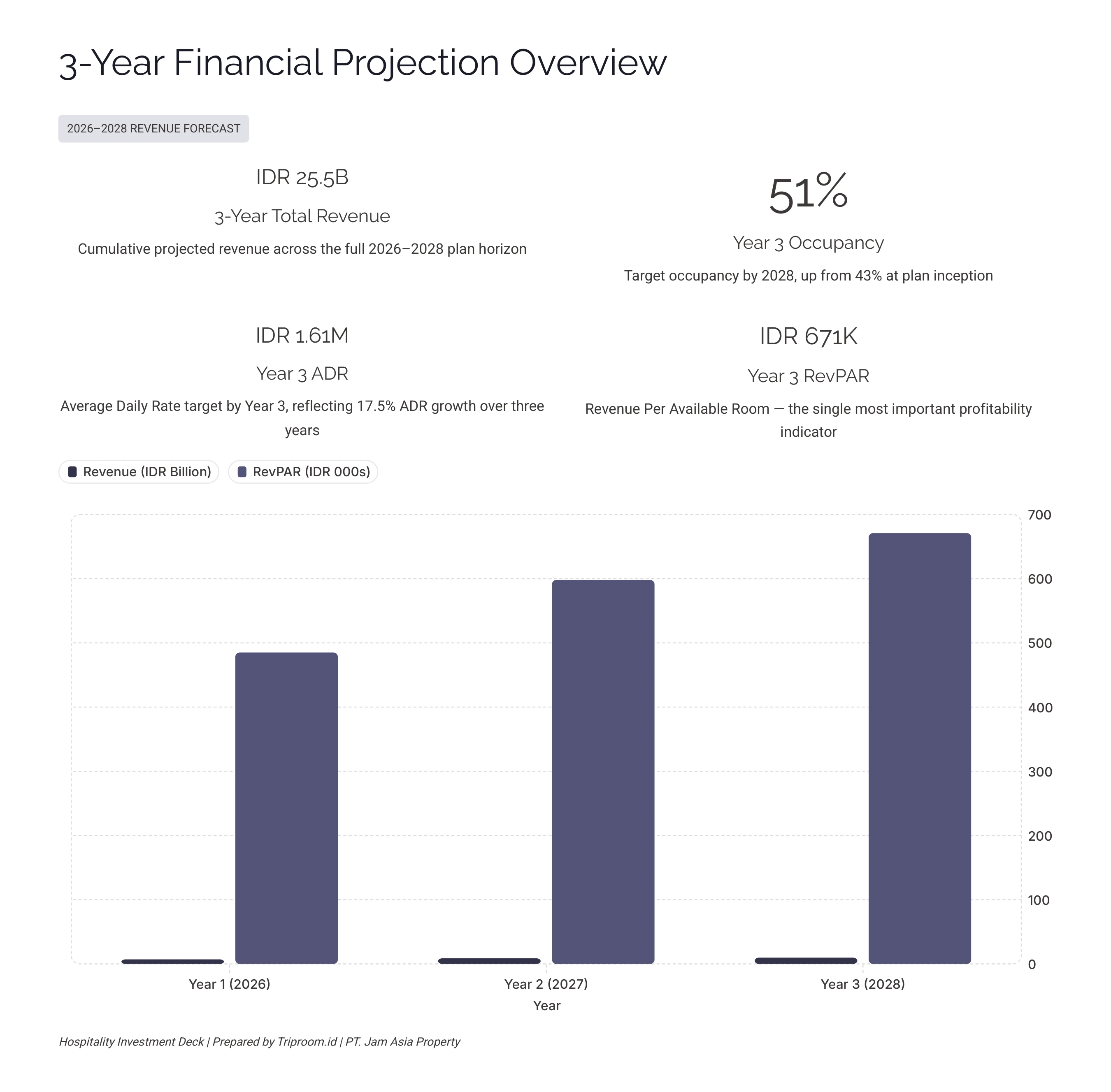
Ashoka Tree Resort Ubud — 3-Year Financial Projection: Revenue IDR 25.5B, RevPAR Growth 2026–2028
IDR 25.5B3-Year Total Revenue
51%Year 3 Occupancy Target
IDR 1.61MYear 3 ADR
IDR 671KYear 3 RevPAR
YearYear 1 (2026)
RevenueIDR 8.29B
Key Metric43% occupancy, IDR 485K RevPAR — operational baseline
YearYear 2 (2027)
RevenueIDR 10.2B
Key Metric23% growth over Year 1 — brand momentum & review improvement
YearYear 3 (2028)
RevenueIDR 11.5B+
Key Metric51% occupancy, IDR 671K RevPAR — brand and operational maturity

ADR & Occupancy Trend

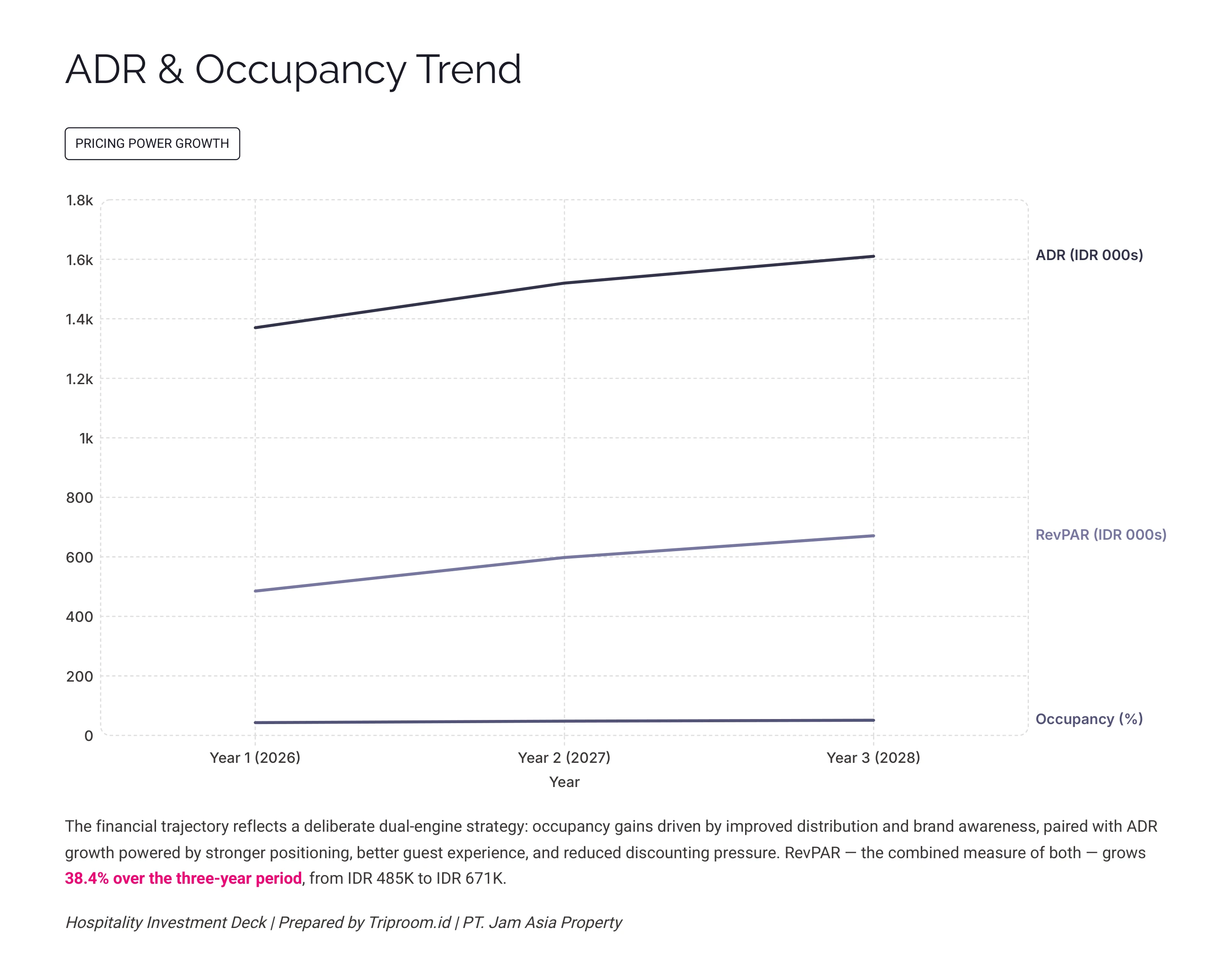
Ashoka Tree Resort Ubud — ADR and Occupancy Trend Chart 2026–2028: RevPAR 38.4% Growth

The financial trajectory reflects a deliberate dual-engine strategy: occupancy gains driven by improved distribution and brand awareness, paired with ADR growth powered by stronger positioning, better guest experience, and reduced discounting pressure. RevPAR — the combined measure of both — grows 38.4% over the three-year period, from IDR 485K to IDR 671K.

Revenue Contribution by Room Category
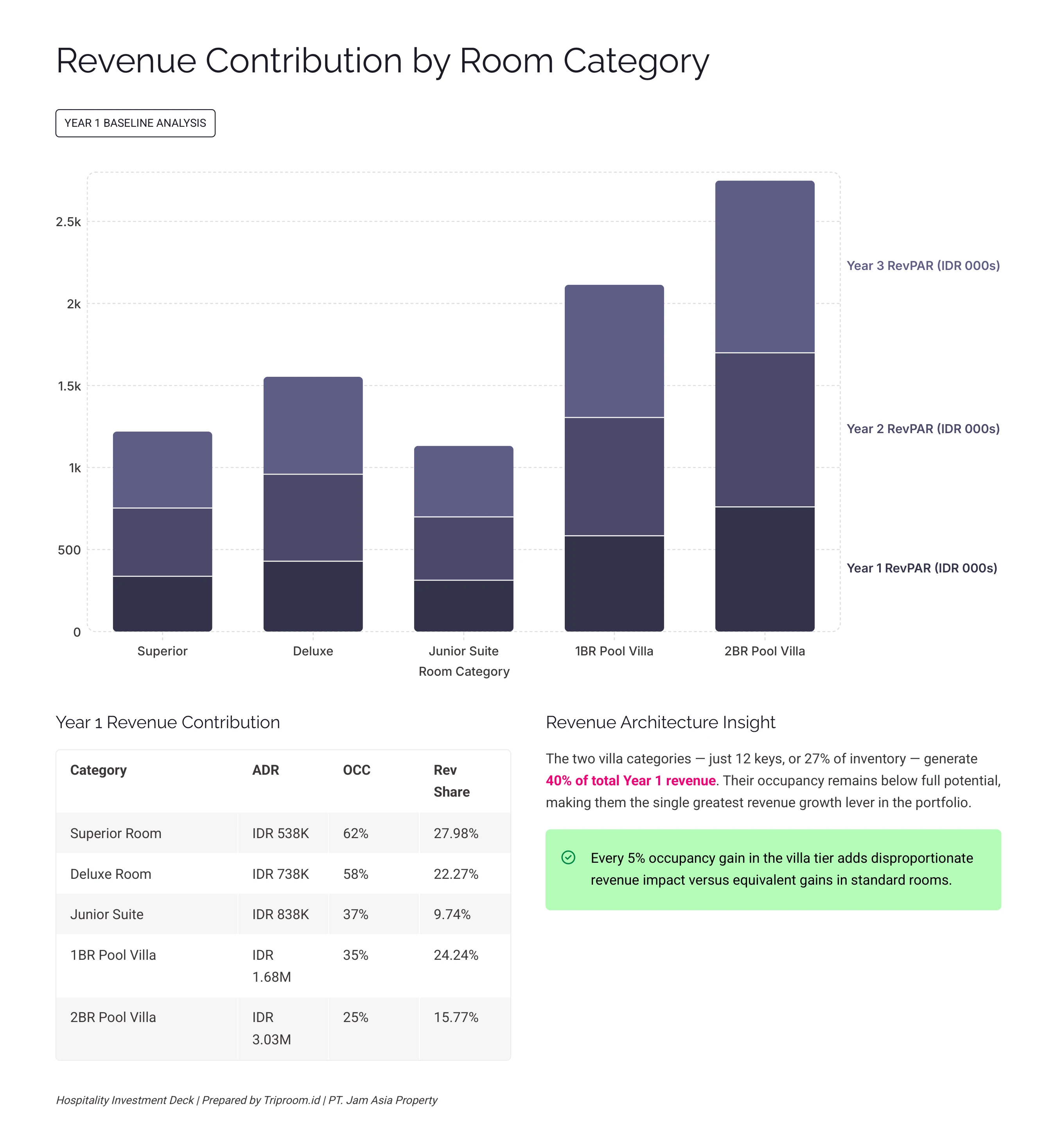
Ashoka Tree Resort Ubud — Revenue Contribution by Room Category: Year 1–3 RevPAR by Category
CategorySuperior Room
ADRIDR 538K
Occupancy62%
Revenue Share27.98%
CategoryDeluxe Room
ADRIDR 738K
Occupancy58%
Revenue Share22.27%
CategoryJunior Suite
ADRIDR 838K
Occupancy37%
Revenue Share9.74%
Category1BR Pool Villa
ADRIDR 1.68M
Occupancy35%
Revenue Share24.24%
Category2BR Pool Villa
ADRIDR 3.03M
Occupancy25%
Revenue Share15.77%
Revenue Architecture Insight

The two villa categories — just 12 keys, or 27% of inventory — generate 40% of total Year 1 revenue. Their occupancy remains below full potential, making them the single greatest revenue growth lever in the portfolio. Every 5% occupancy gain in the villa tier adds disproportionate revenue impact versus equivalent gains in standard rooms.

Strategic Financial Insights — Revenue Crown Jewels

One Bedroom Private Pool Villa

At IDR 1.68M ADR with a 35% Year 1 occupancy, the 1BR villa is significantly underoccupied relative to its emotional and pricing potential. Targeted honeymoon marketing and wellness package bundling can move occupancy to 41% by Year 3 — adding substantial RevPAR uplift.

Two Bedroom Private Pool Villa

The 2BR villa commands IDR 3.03M ADR in Year 1, rising to IDR 3.57M by Year 3. With only 4 keys, even modest occupancy improvements create outsized revenue impact. The 2BR villa is the portfolio's highest-leverage, highest-margin asset.

The strategic case is clear: villa tier pricing power, emotional appeal to honeymooners, and upselling potential from standard room bookers creates a revenue flywheel. The villas don't just generate revenue — they anchor the brand's romantic premium positioning across every touchpoint.

RevPAR: The Profitability Indicator That Matters

Revenue Per Available Room is the hospitality industry's most powerful single metric because it cannot be gamed by discounting. A hotel can inflate occupancy by slashing rates — but RevPAR reveals the truth. It captures both pricing integrity and operational fill efficiency in a single number.

IDR 485KYear 1 RevPAR (2026)
IDR 598KYear 2 RevPAR (2027)
IDR 671KYear 3 RevPAR (2028)

Ashoka Tree Resort's RevPAR growth of +38.4% over three years reflects a property gaining both pricing confidence and market share simultaneously — the hallmark of a well-executed repositioning strategy. This trajectory is achievable without major capital expenditure, driven primarily by branding, distribution optimization, and experience enhancement.

Peak Season Performance
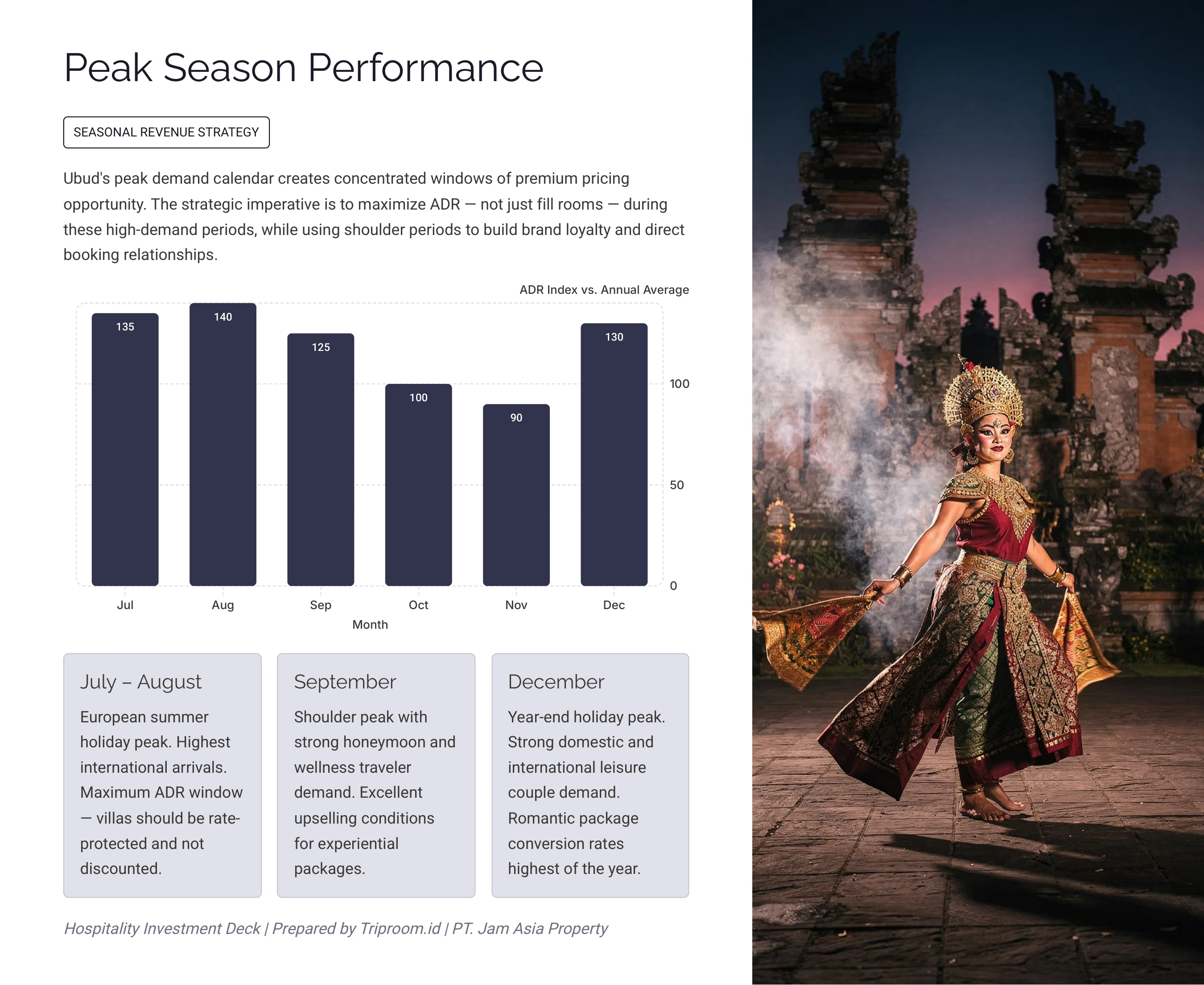
Ashoka Tree Resort Ubud — Peak Season ADR Index by Month: July–August, September, December Peaks

Ubud's peak demand calendar creates concentrated windows of premium pricing opportunity. The strategic imperative is to maximize ADR — not just fill rooms — during these high-demand periods, while using shoulder periods to build brand loyalty and direct booking relationships.

Peak PeriodJuly – August
ADR Index135–140
StrategyEuropean summer holiday peak. Highest international arrivals. Maximum ADR window — villas should be rate-protected and not discounted.
Peak PeriodSeptember
ADR Index125
StrategyShoulder peak with strong honeymoon and wellness traveler demand. Excellent upselling conditions for experiential packages.
Peak PeriodOctober–November
ADR Index90–100
StrategyShoulder period — focus on domestic market activation and loyalty programs.
Peak PeriodDecember
ADR Index130
StrategyYear-end holiday peak. Strong domestic and international leisure couple demand. Romantic package conversion rates highest of the year.

Financial Risks & Mitigation Strategy

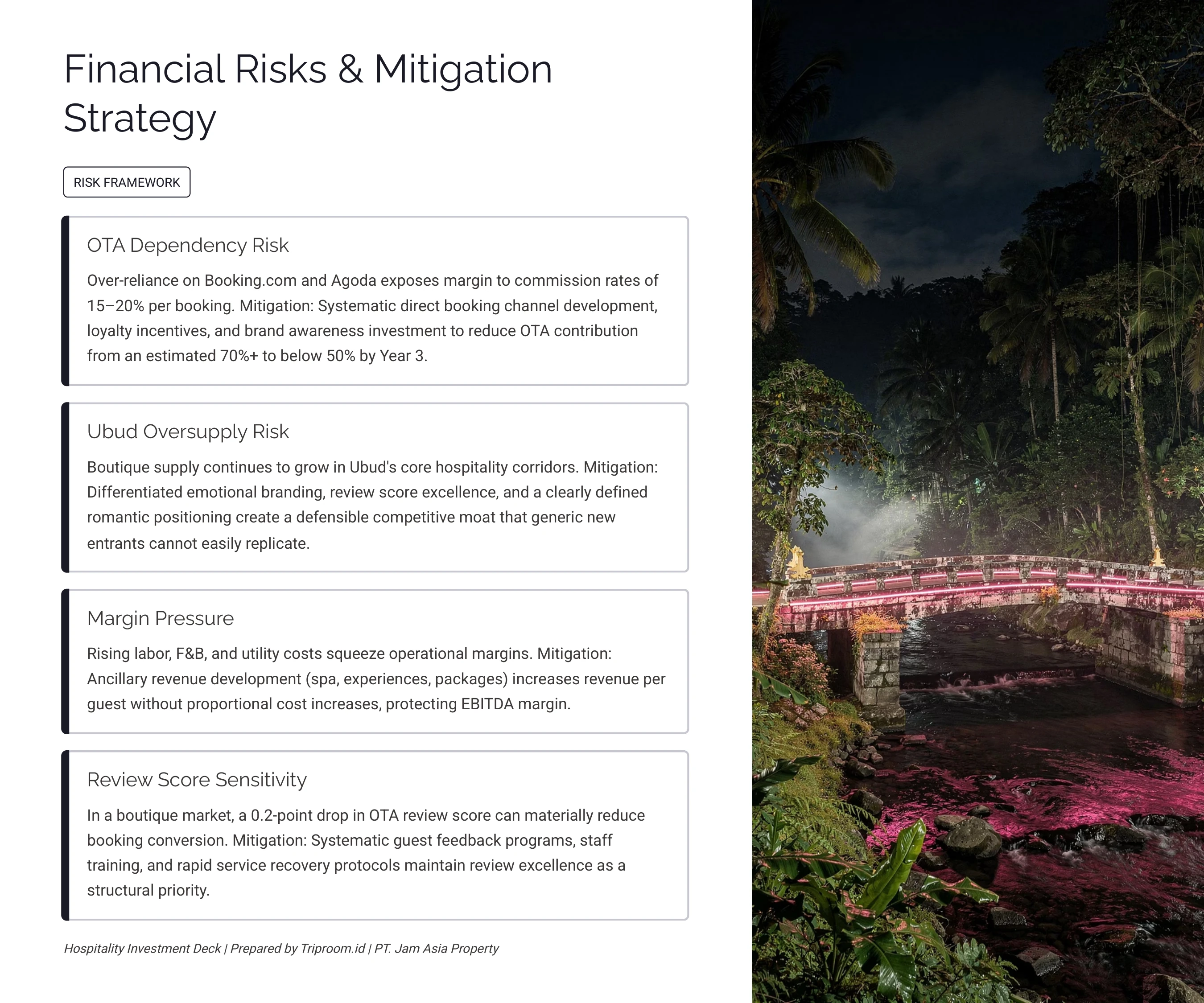
Ashoka Tree Resort Ubud — Financial Risks and Mitigation Strategy Framework
OTA Dependency RiskOver-reliance on Booking.com and Agoda exposes margin to commission rates of 15–20% per booking. Mitigation: Systematic direct booking channel development, loyalty incentives, and brand awareness investment to reduce OTA contribution from an estimated 70%+ to below 50% by Year 3.
Ubud Oversupply RiskBoutique supply continues to grow in Ubud's core hospitality corridors. Mitigation: Differentiated emotional branding, review score excellence, and a clearly defined romantic positioning create a defensible competitive moat that generic new entrants cannot easily replicate.
Margin PressureRising labor, F&B, and utility costs squeeze operational margins. Mitigation: Ancillary revenue development (spa, experiences, packages) increases revenue per guest without proportional cost increases, protecting EBITDA margin.
Review Score SensitivityIn a boutique market, a 0.2-point drop in OTA review score can materially reduce booking conversion. Mitigation: Systematic guest feedback programs, staff training, and rapid service recovery protocols maintain review excellence as a structural priority.

Ancillary Revenue Opportunities

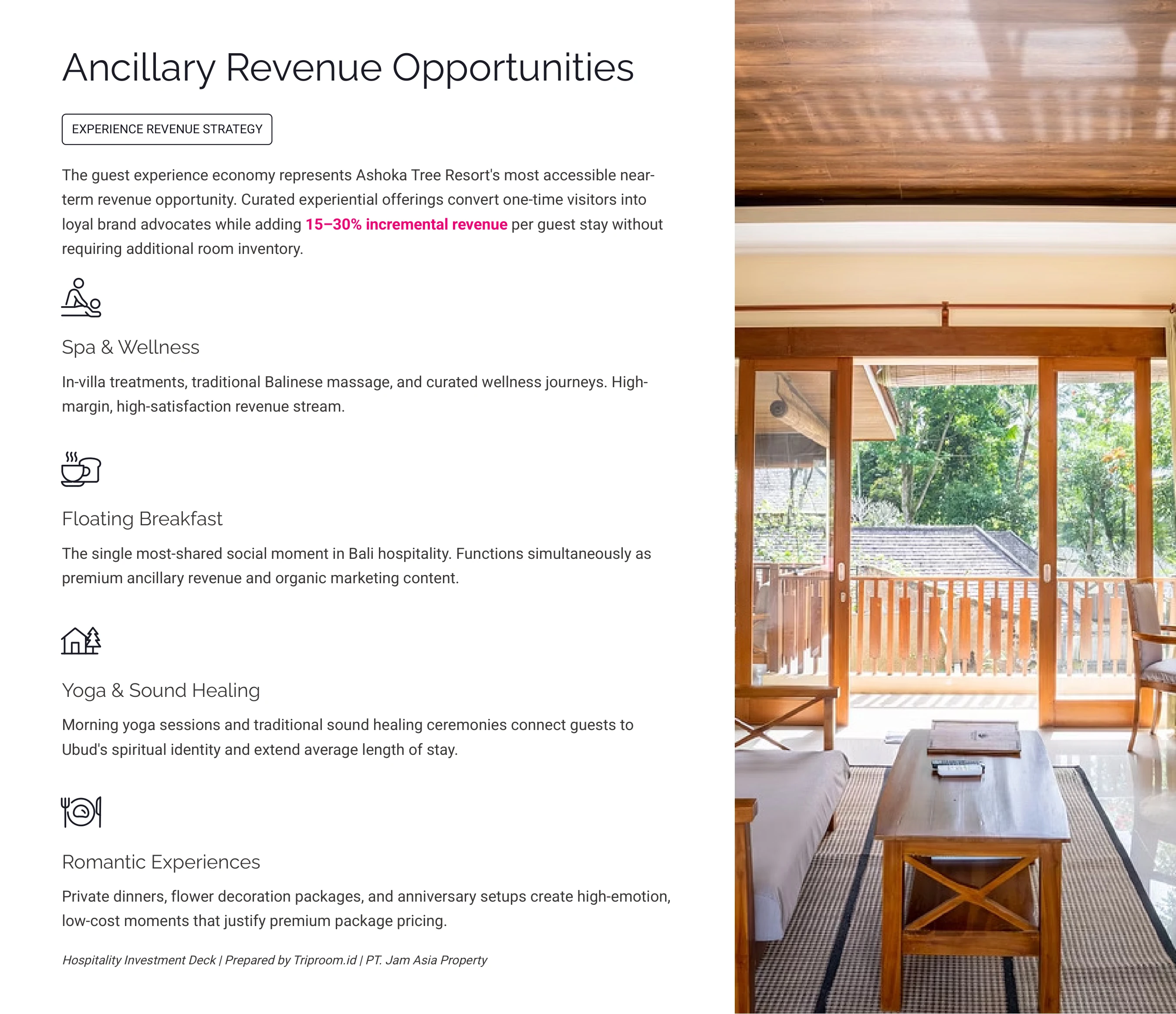
Ashoka Tree Resort Ubud — Ancillary Revenue: Spa, Floating Breakfast, Yoga, Romantic Experiences

The guest experience economy represents Ashoka Tree Resort's most accessible near-term revenue opportunity. Curated experiential offerings convert one-time visitors into loyal brand advocates while adding 15–30% incremental revenue per guest stay without requiring additional room inventory.

Spa & WellnessIn-villa treatments, traditional Balinese massage, and curated wellness journeys. High-margin, high-satisfaction revenue stream.
Floating BreakfastThe single most-shared social moment in Bali hospitality. Functions simultaneously as premium ancillary revenue and organic marketing content.
Yoga & Sound HealingMorning yoga sessions and traditional sound healing ceremonies connect guests to Ubud's spiritual identity and extend average length of stay.
Romantic ExperiencesPrivate dinners, flower decoration packages, and anniversary setups create high-emotion, low-cost moments that justify premium package pricing.

Strategic Priorities Roadmap 2026–2028
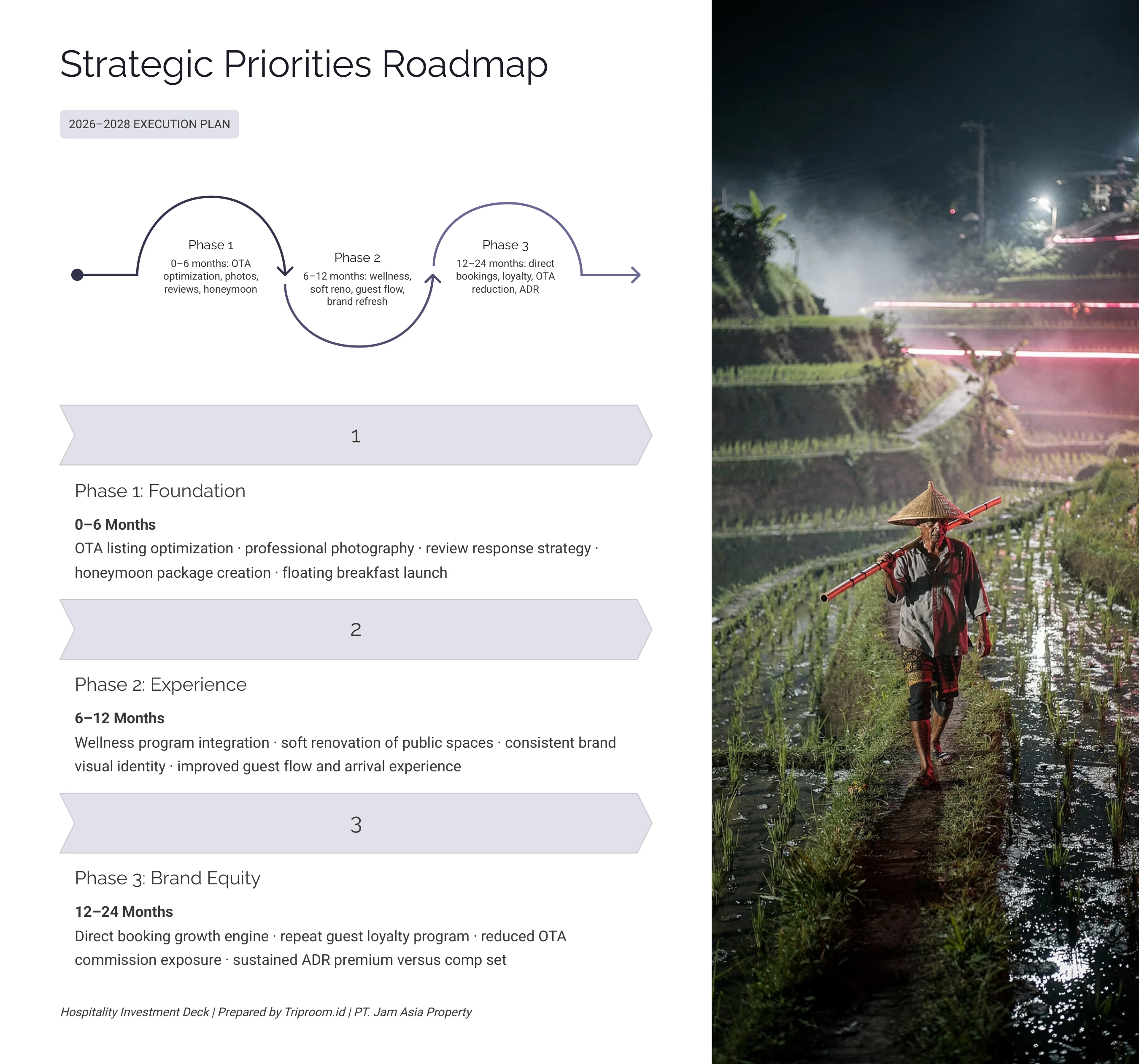
Ashoka Tree Resort Ubud — Strategic Priorities Roadmap: Phase 1 Foundation, Phase 2 Experience, Phase 3 Brand Equity
PhasePhase 1: Foundation
Timeline0–6 Months
Focus AreasOTA listing optimization · professional photography · review response strategy · honeymoon package creation · floating breakfast launch
PhasePhase 2: Experience
Timeline6–12 Months
Focus AreasWellness program integration · soft renovation of public spaces · consistent brand visual identity · improved guest flow and arrival experience
PhasePhase 3: Brand Equity
Timeline12–24 Months
Focus AreasDirect booking growth engine · repeat guest loyalty program · reduced OTA commission exposure · sustained ADR premium versus comp set

Year-by-Year Room Category Performance
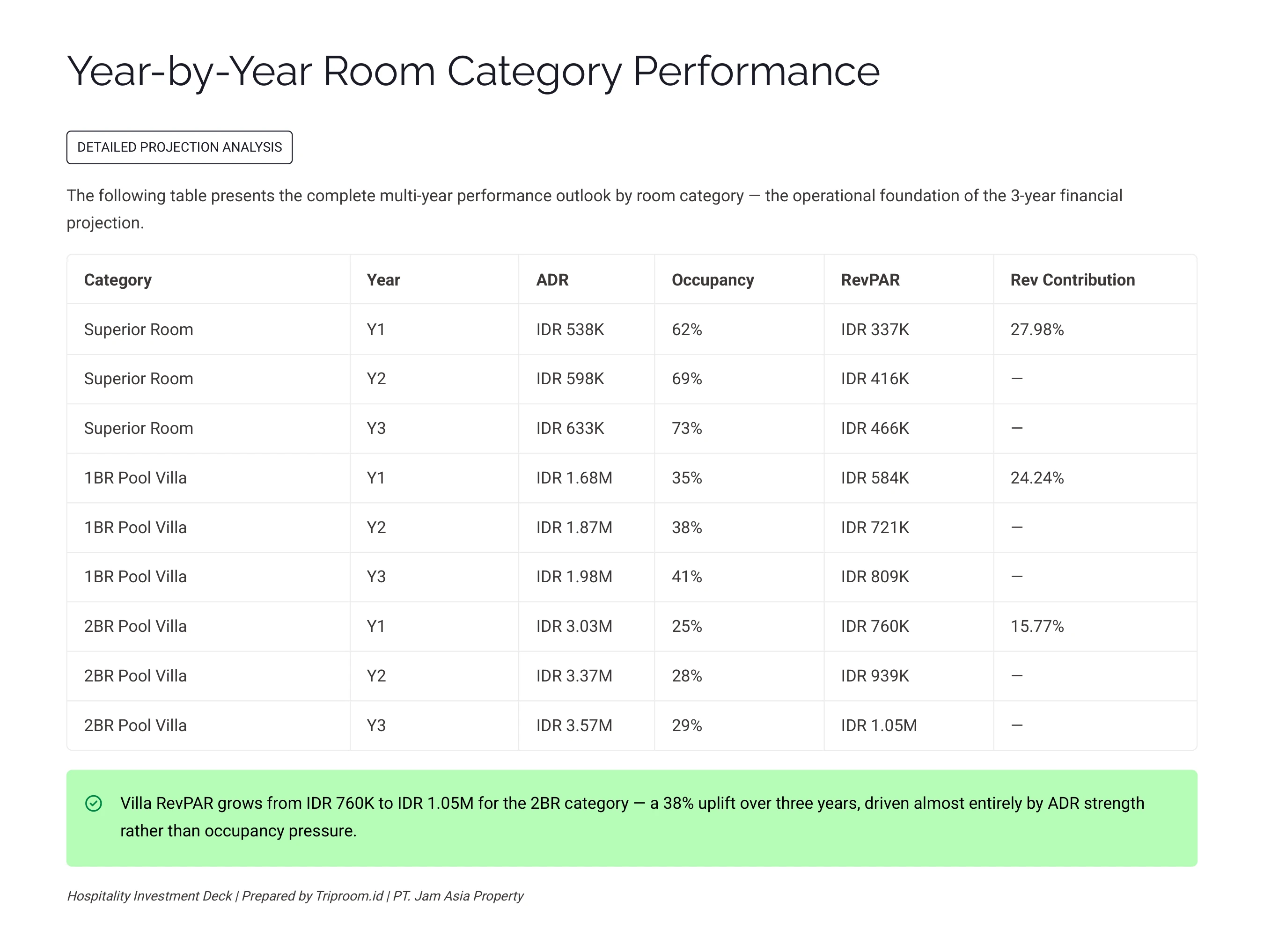
Ashoka Tree Resort Ubud — Year-by-Year Room Category Performance: ADR, Occupancy, RevPAR by Category

The following table presents the complete multi-year performance outlook by room category — the operational foundation of the 3-year financial projection.

CategorySuperior Room
YearY1
ADRIDR 538K
Occupancy62%
RevPARIDR 337K
Rev Contribution27.98%
CategorySuperior Room
YearY2
ADRIDR 598K
Occupancy69%
RevPARIDR 416K
Rev Contribution
CategorySuperior Room
YearY3
ADRIDR 633K
Occupancy73%
RevPARIDR 466K
Rev Contribution
Category1BR Pool Villa
YearY1
ADRIDR 1.68M
Occupancy35%
RevPARIDR 584K
Rev Contribution24.24%
Category1BR Pool Villa
YearY2
ADRIDR 1.87M
Occupancy38%
RevPARIDR 721K
Rev Contribution

Villa RevPAR grows from IDR 760K to IDR 1.05M for the 2BR category — a 38% uplift over three years, driven almost entirely by ADR strength rather than occupancy pressure.

The Future of Bali Hospitality

Emotionally Branded ResortsProperties with a clear emotional identity command loyalty that is nearly impossible for competitors to buy away with discounts.
Experiential HospitalityEvery curated moment — from arrival to departure — is a retention tool, a marketing asset, and a revenue opportunity simultaneously.
Boutique Wellness RetreatsThe intersection of jungle sanctuary, mindfulness programming, and romantic intimacy defines the highest-growth segment in Bali's evolving hospitality landscape.
Differentiated Guest ExperiencesThe properties that survive the next decade will compete on meaning, not price. Ubud rewards those who invest in depth of experience over breadth of inventory.

Closing Vision — Strategic Plan

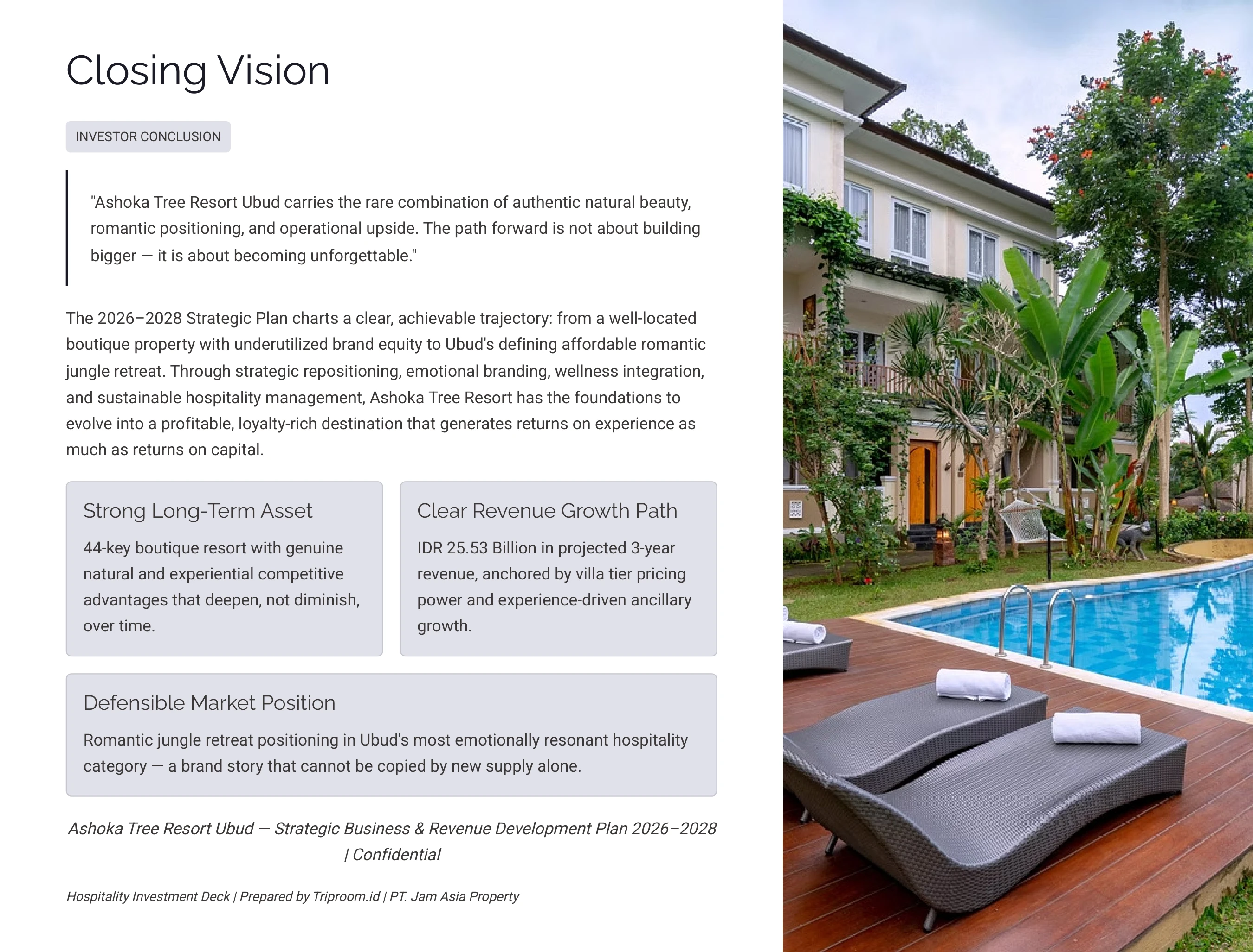
Ashoka Tree Resort Ubud — Closing Vision: Strategic Business Plan Investor Conclusion
Investor Conclusion

Ashoka Tree Resort Ubud carries the rare combination of authentic natural beauty, romantic positioning, and operational upside. The path forward is not about building bigger — it is about becoming unforgettable.

The 2026–2028 Strategic Plan charts a clear, achievable trajectory: from a well-located boutique property with underutilized brand equity to Ubud's defining affordable romantic jungle retreat. Through strategic repositioning, emotional branding, wellness integration, and sustainable hospitality management, Ashoka Tree Resort has the foundations to evolve into a profitable, loyalty-rich destination that generates returns on experience as much as returns on capital.

Strong Long-Term Asset44-key boutique resort with genuine natural and experiential competitive advantages that deepen, not diminish, over time.
Clear Revenue Growth PathIDR 25.53 Billion in projected 3-year revenue, anchored by villa tier pricing power and experience-driven ancillary growth.
Defensible Market PositionRomantic jungle retreat positioning in Ubud's most emotionally resonant hospitality category — a brand story that cannot be copied by new supply alone.

Flash P&L & Financial Performance Illustration
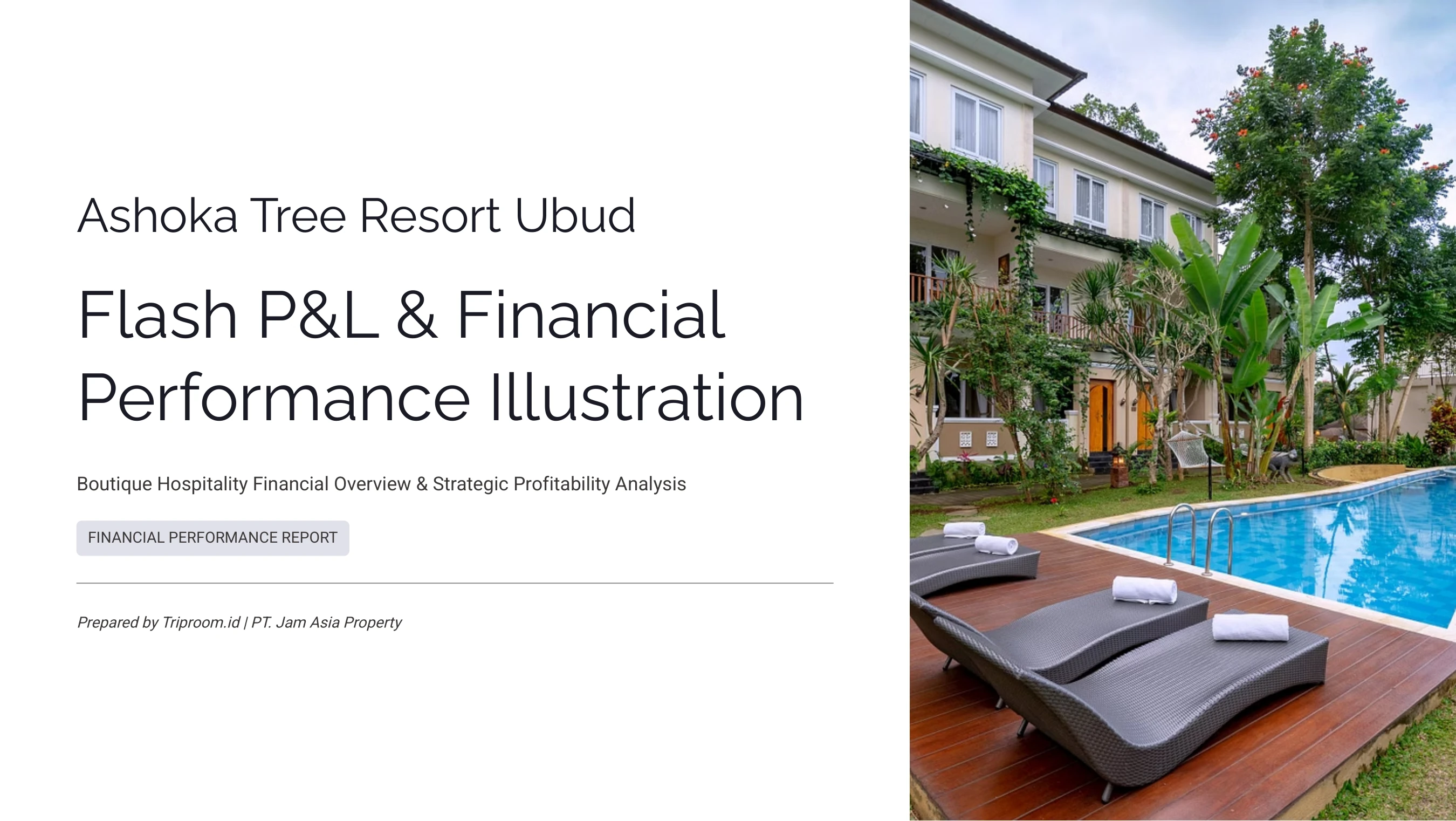
Ashoka Tree Resort Ubud — Flash P&L and Financial Performance Illustration Cover

The following section presents the boutique hospitality financial overview and strategic profitability analysis for Ashoka Tree Resort Ubud, prepared by Triproom.id | PT. Jam Asia Property.

The New Measure of Hospitality Success

Fill rooms. Drive occupancy. Compete on OTA rate. Hope the market lifts all boats.Sustainable RevPAR growth. Emotional brand equity. Direct booking strength. Experiential revenue. Operational discipline.
Performance Standard

Strong hospitality assets are built through sustainable RevPAR growth, not occupancy alone.

Property Overview — 44 Keys
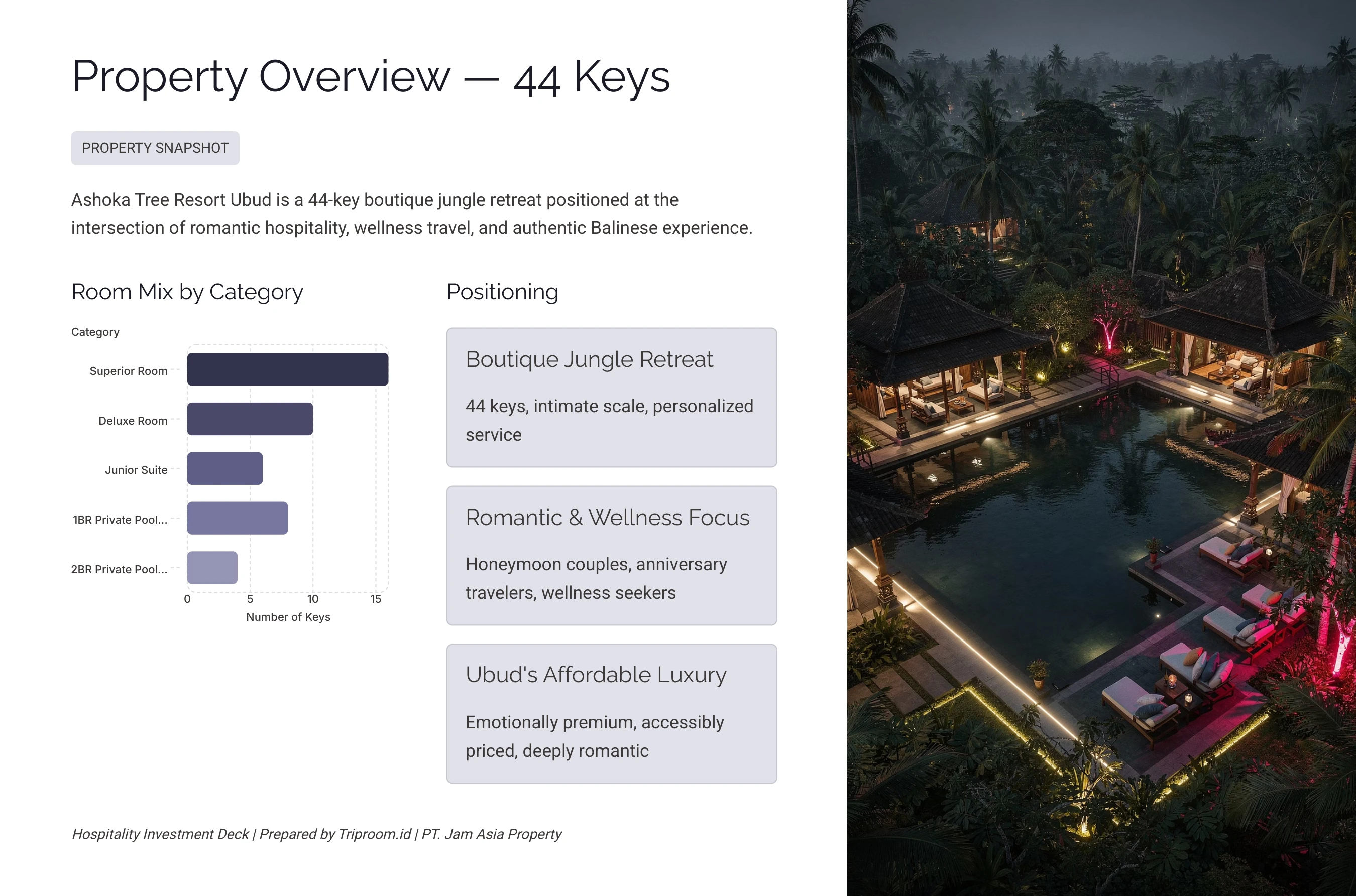
Ashoka Tree Resort Ubud — Property Overview: 44 Keys Room Mix by Category

Ashoka Tree Resort Ubud is a 44-key boutique jungle retreat positioned at the intersection of romantic hospitality, wellness travel, and authentic Balinese experience.

Boutique Jungle Retreat44 keys, intimate scale, personalized service
Romantic & Wellness FocusHoneymoon couples, anniversary travelers, wellness seekers
Ubud's Affordable LuxuryEmotionally premium, accessibly priced, deeply romantic

Year 1 Operational Summary — 2026 Baseline
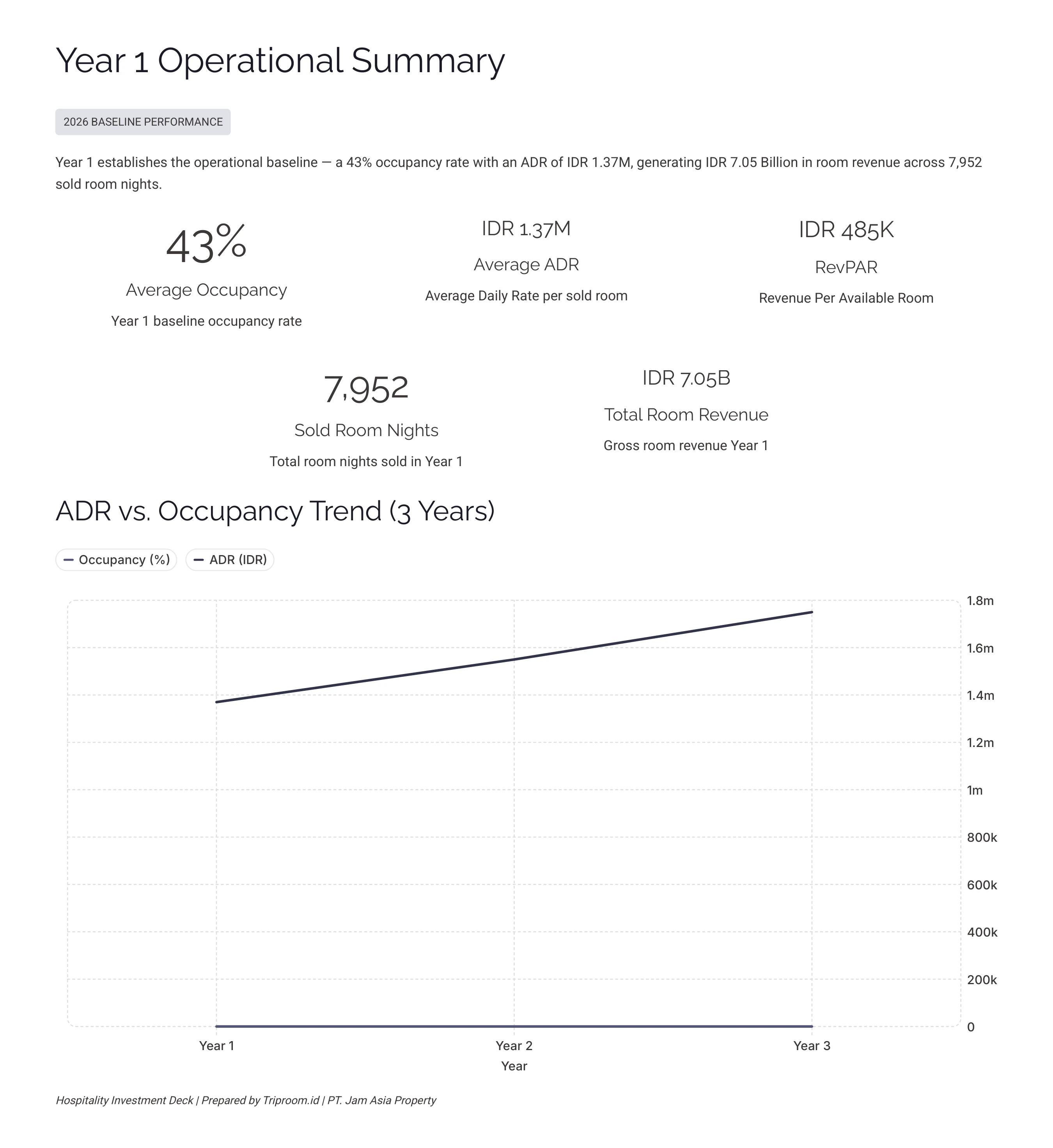
Ashoka Tree Resort Ubud — Year 1 Operational Summary: 43% Occupancy, IDR 1.37M ADR, IDR 7.05B Revenue

Year 1 establishes the operational baseline — a 43% occupancy rate with an ADR of IDR 1.37M, generating IDR 7.05 Billion in room revenue across 7,952 sold room nights.

43%Average Occupancy
IDR 1.37MAverage ADR
IDR 485KRevPAR
7,952Sold Room Nights
IDR 7.05BTotal Room Revenue

Total Revenue Composition — Year 1

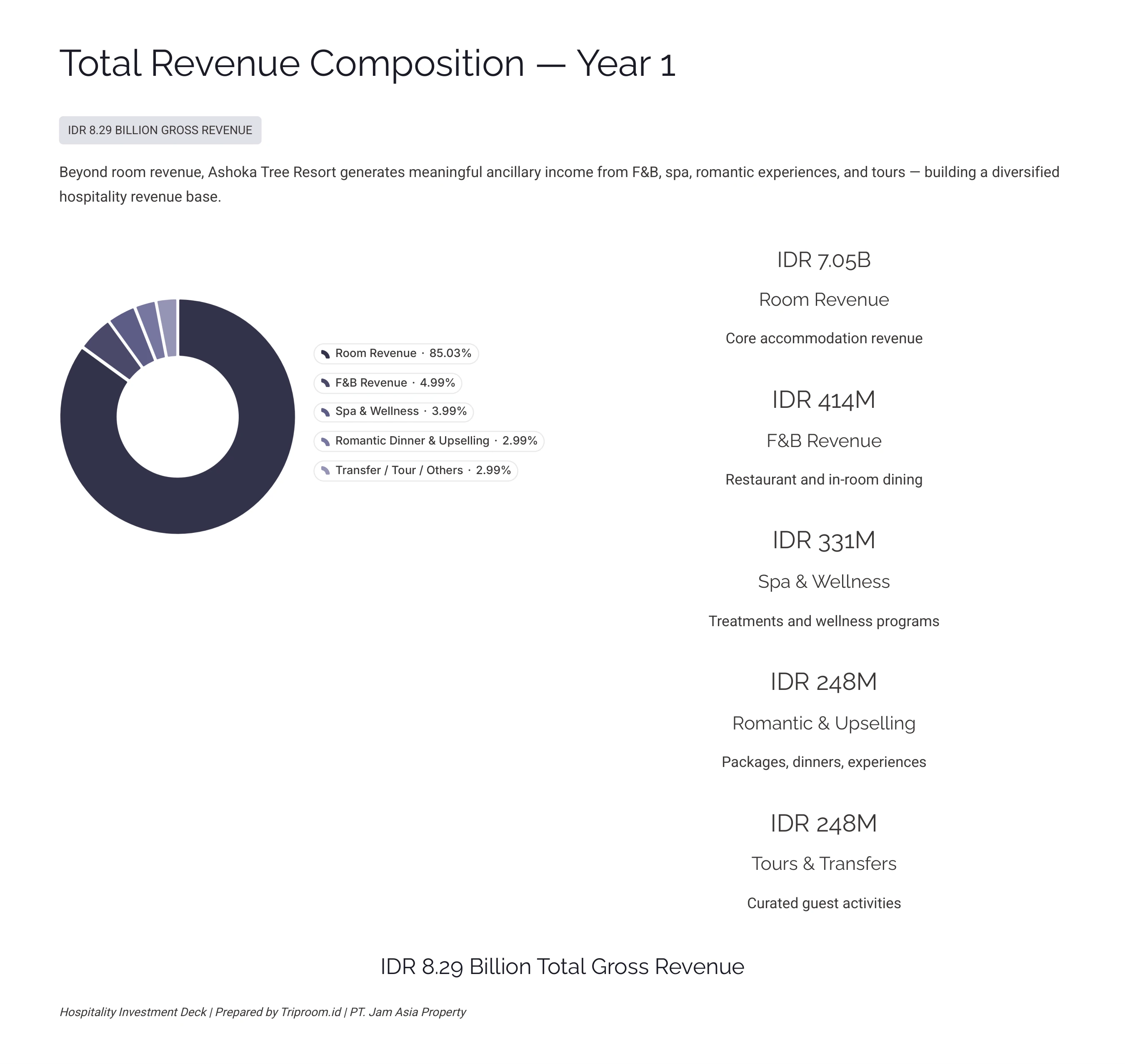
Ashoka Tree Resort Ubud — Total Revenue Composition Year 1: IDR 8.29B Gross Revenue by Department

Beyond room revenue, Ashoka Tree Resort generates meaningful ancillary income from F&B, spa, romantic experiences, and tours — building a diversified hospitality revenue base.

Revenue StreamRoom Revenue
AmountIDR 7.05B
Share85.03%
Revenue StreamF&B Revenue
AmountIDR 414M
Share4.99%
Revenue StreamSpa & Wellness
AmountIDR 331M
Share3.99%
Revenue StreamRomantic Dinner & Upselling
AmountIDR 248M
Share2.99%
Revenue StreamTransfer / Tour / Others
AmountIDR 248M
Share2.99%
Revenue StreamTotal Gross Revenue
AmountIDR 8.29B
Share100%

Departmental Operating Expenses — Year 1
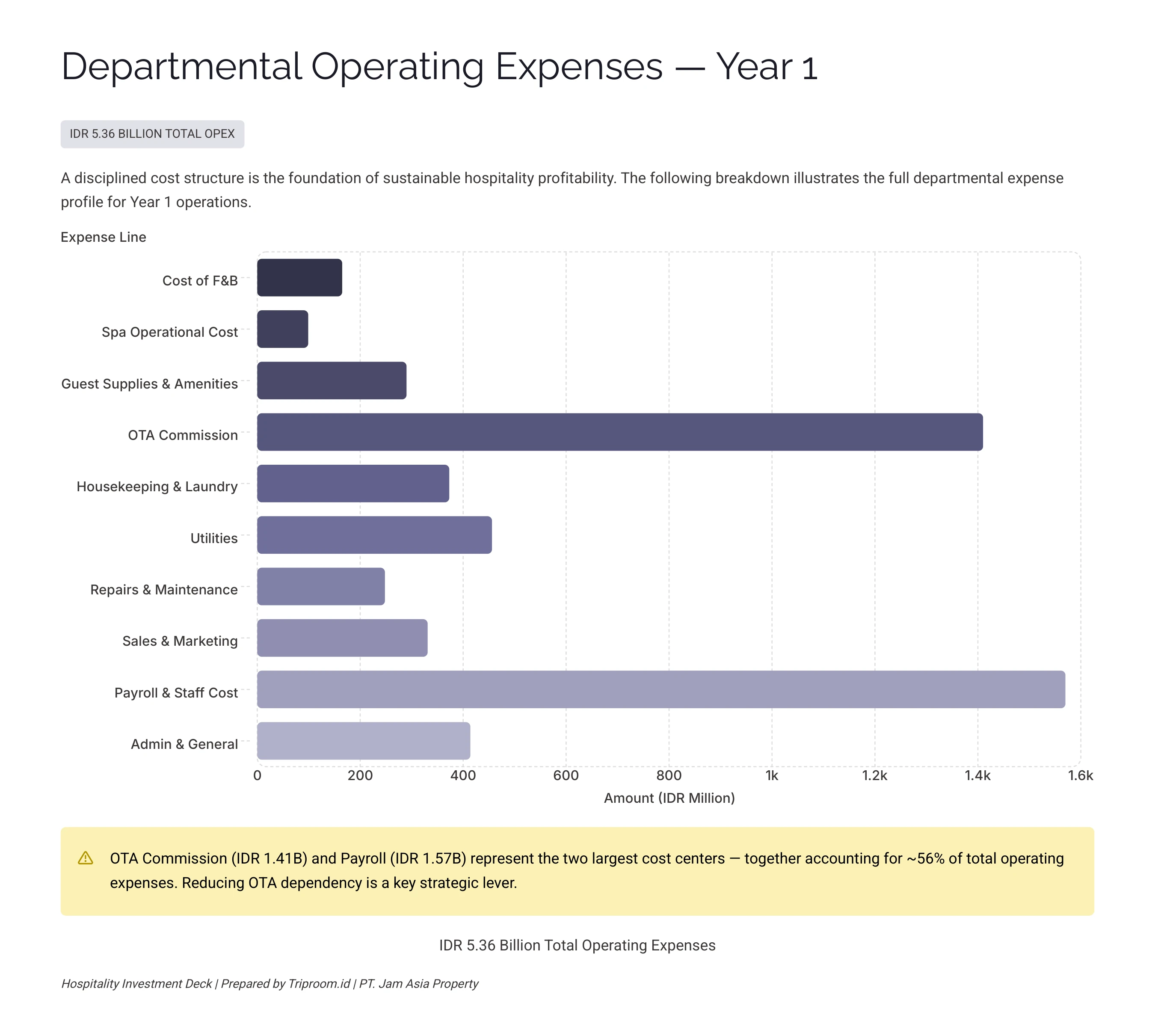
Ashoka Tree Resort Ubud — Departmental Operating Expenses Year 1: IDR 5.36B Total OpEx Breakdown

A disciplined cost structure is the foundation of sustainable hospitality profitability. OTA Commission (IDR 1.41B) and Payroll (IDR 1.57B) represent the two largest cost centers — together accounting for ~56% of total operating expenses. Reducing OTA dependency is a key strategic lever.

Payroll & Staff CostIDR 1.57B — largest single expense; reducing turnover a key margin lever
OTA CommissionIDR 1.41B — ~17% of revenue; target reduction to ~12% by Year 3
Admin & GeneralOverhead management and administrative operations
Sales & MarketingOTA listing optimization and brand awareness investment
Repairs & MaintenanceProperty upkeep and preventive maintenance program
IDR 5.36BTotal Operating Expenses

Gross Operating Profit — Year 1

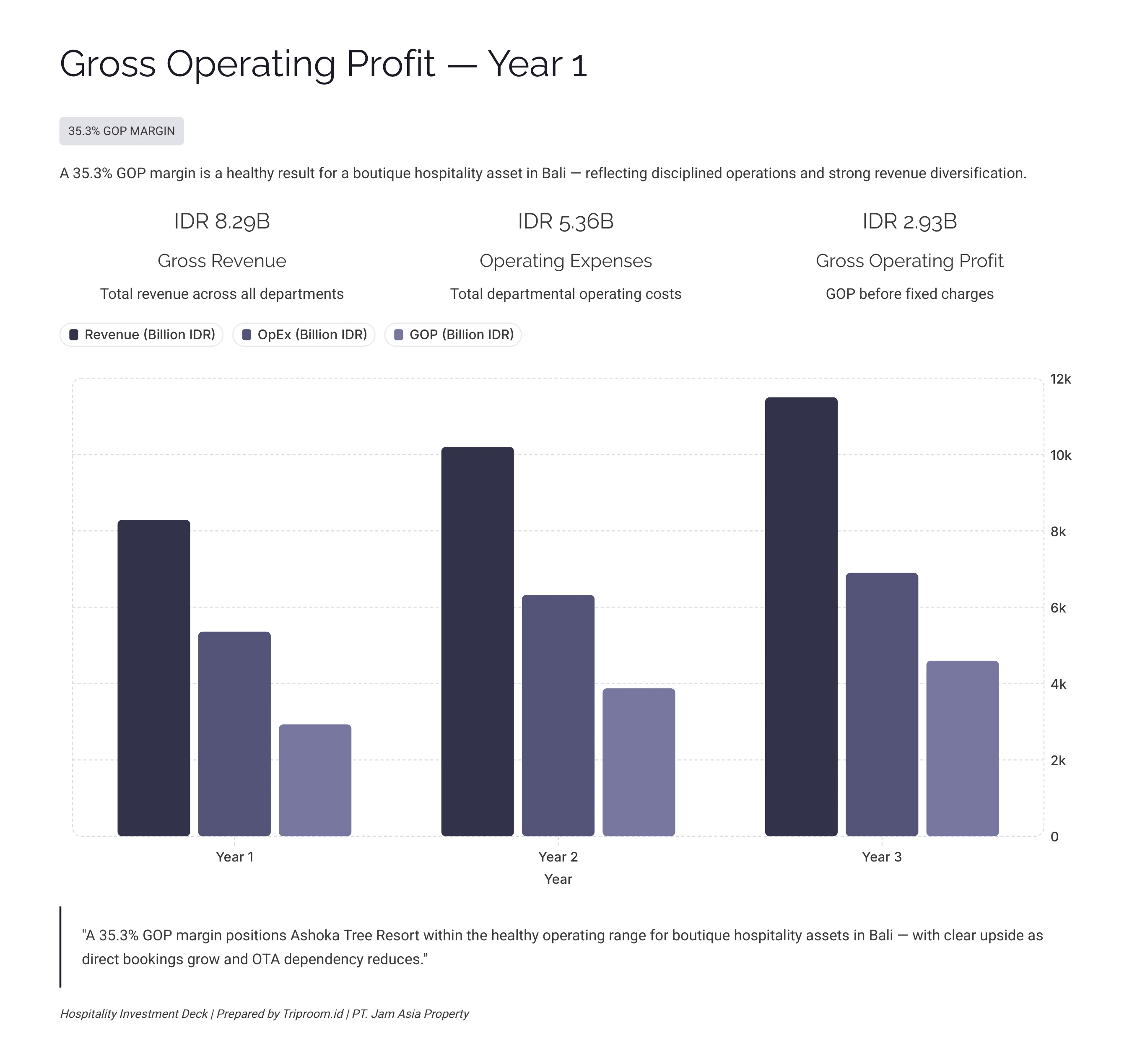
Ashoka Tree Resort Ubud — Gross Operating Profit Year 1: IDR 2.93B GOP, 35.3% Margin
IDR 8.29BGross Revenue
IDR 5.36BOperating Expenses
IDR 2.93BGross Operating Profit
35.3%GOP Margin
GOP Analysis

A 35.3% GOP margin positions Ashoka Tree Resort within the healthy operating range for boutique hospitality assets in Bali — with clear upside as direct bookings grow and OTA dependency reduces.

EBITDA Illustration — Year 1
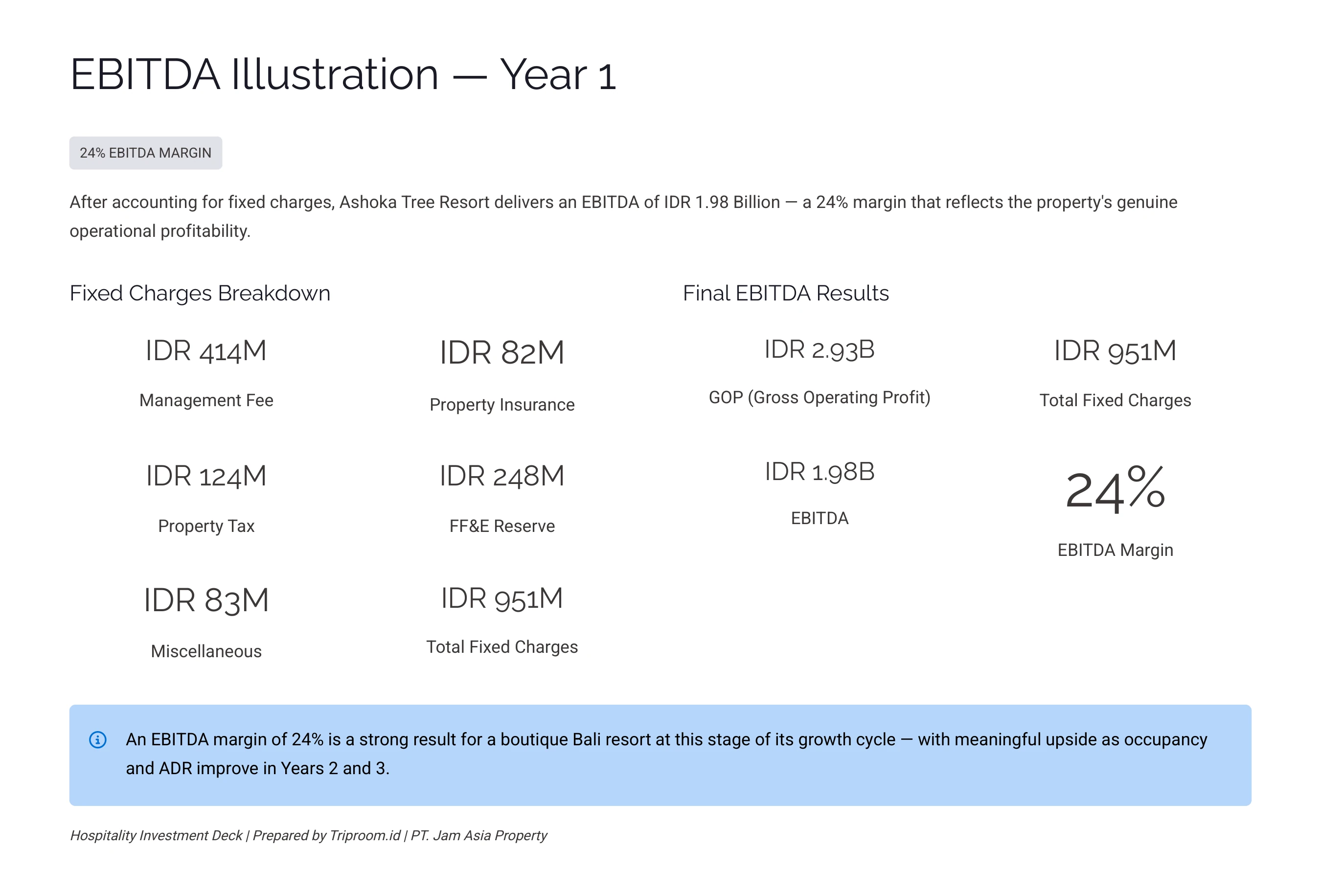
Ashoka Tree Resort Ubud — EBITDA Illustration Year 1: IDR 1.98B EBITDA, 24% Margin

After accounting for fixed charges, Ashoka Tree Resort delivers an EBITDA of IDR 1.98 Billion — a 24% margin that reflects the property's genuine operational profitability.

Management FeeIDR 414M
Property InsuranceIDR 82M
Property TaxIDR 124M
FF&E ReserveIDR 248M
MiscellaneousIDR 83M
Total Fixed ChargesIDR 951M
IDR 2.93BGOP (Gross Operating Profit)
IDR 951MTotal Fixed Charges
IDR 1.98BEBITDA
24%EBITDA Margin

An EBITDA margin of 24% is a strong result for a boutique Bali resort at this stage of its growth cycle — with meaningful upside as occupancy and ADR improve in Years 2 and 3.

Villa Revenue — The Profitability Crown Jewels
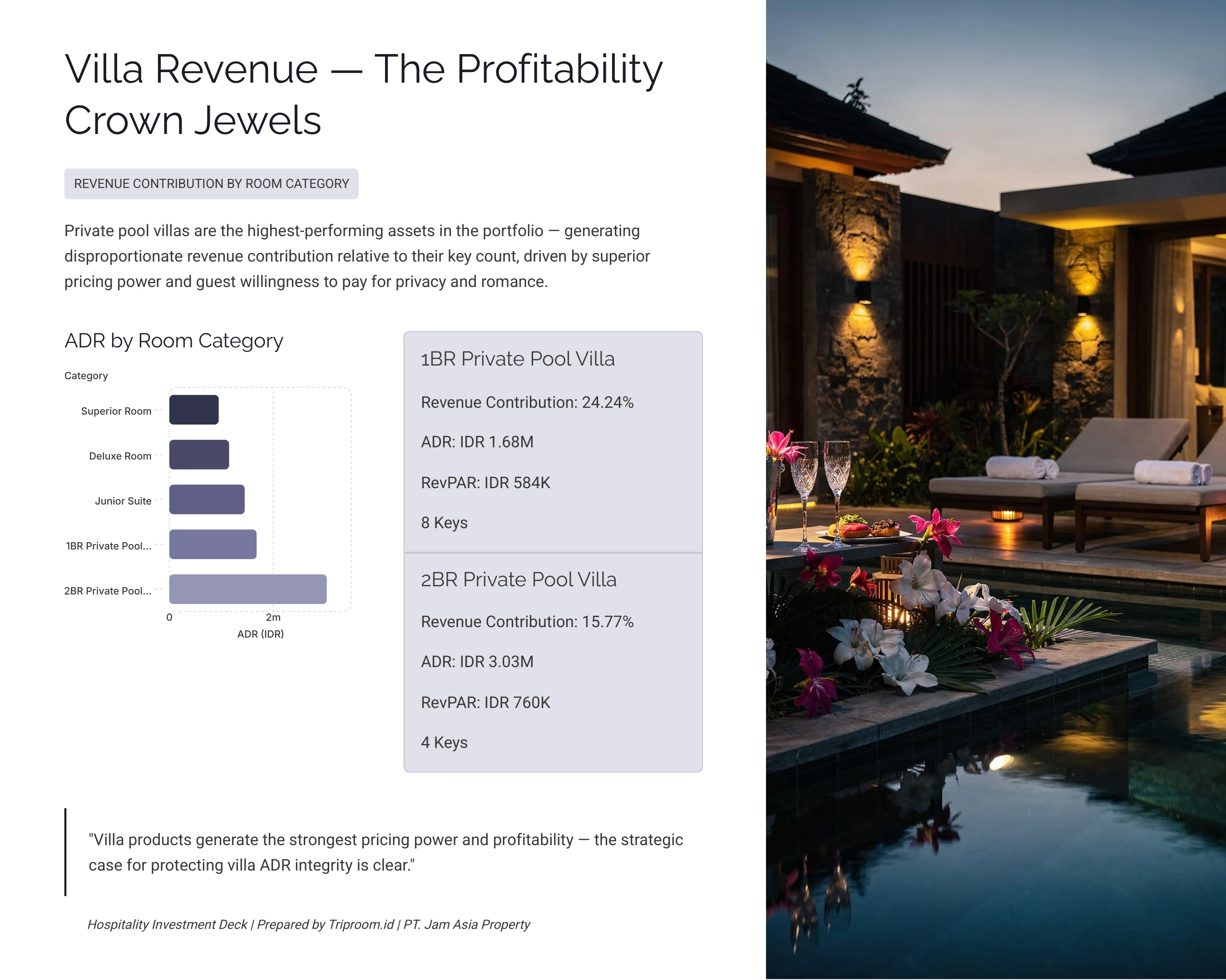
Ashoka Tree Resort Ubud — Villa Revenue Crown Jewels: 1BR and 2BR Private Pool Villa ADR by Category

Private pool villas are the highest-performing assets in the portfolio — generating disproportionate revenue contribution relative to their key count, driven by superior pricing power and guest willingness to pay for privacy and romance.

Villa Category1BR Private Pool Villa
Revenue Share24.24%
ADRIDR 1.68M
RevPARIDR 584K
Keys8
Villa Category2BR Private Pool Villa
Revenue Share15.77%
ADRIDR 3.03M
RevPARIDR 760K
Keys4
Villa Thesis

Villa products generate the strongest pricing power and profitability — the strategic case for protecting villa ADR integrity is clear.

Where the Real Revenue Lives
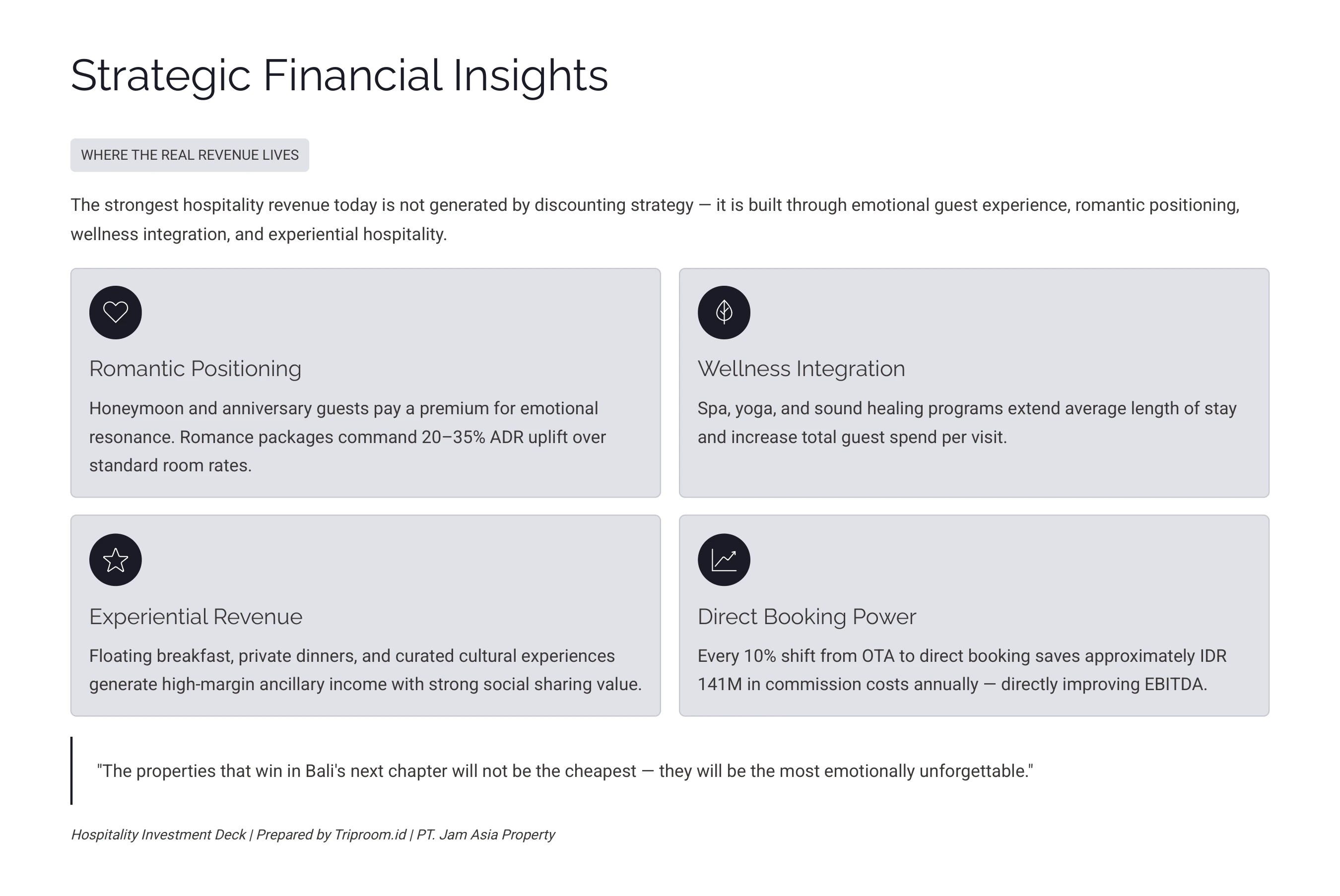
Ashoka Tree Resort Ubud — Where the Real Revenue Lives: Romantic Positioning, Wellness, Experiential Revenue, Direct Booking

The strongest hospitality revenue today is not generated by discounting strategy — it is built through emotional guest experience, romantic positioning, wellness integration, and experiential hospitality.

Romantic PositioningHoneymoon and anniversary guests pay a premium for emotional resonance. Romance packages command 20–35% ADR uplift over standard room rates.
Wellness IntegrationSpa, yoga, and sound healing programs extend average length of stay and increase total guest spend per visit.
Experiential RevenueFloating breakfast, private dinners, and curated cultural experiences generate high-margin ancillary income with strong social sharing value.
Direct Booking PowerEvery 10% shift from OTA to direct booking saves approximately IDR 141M in commission costs annually — directly improving EBITDA.
Strategic Truth

The properties that win in Bali's next chapter will not be the cheapest — they will be the most emotionally unforgettable.

Main Financial Risks & Mitigation
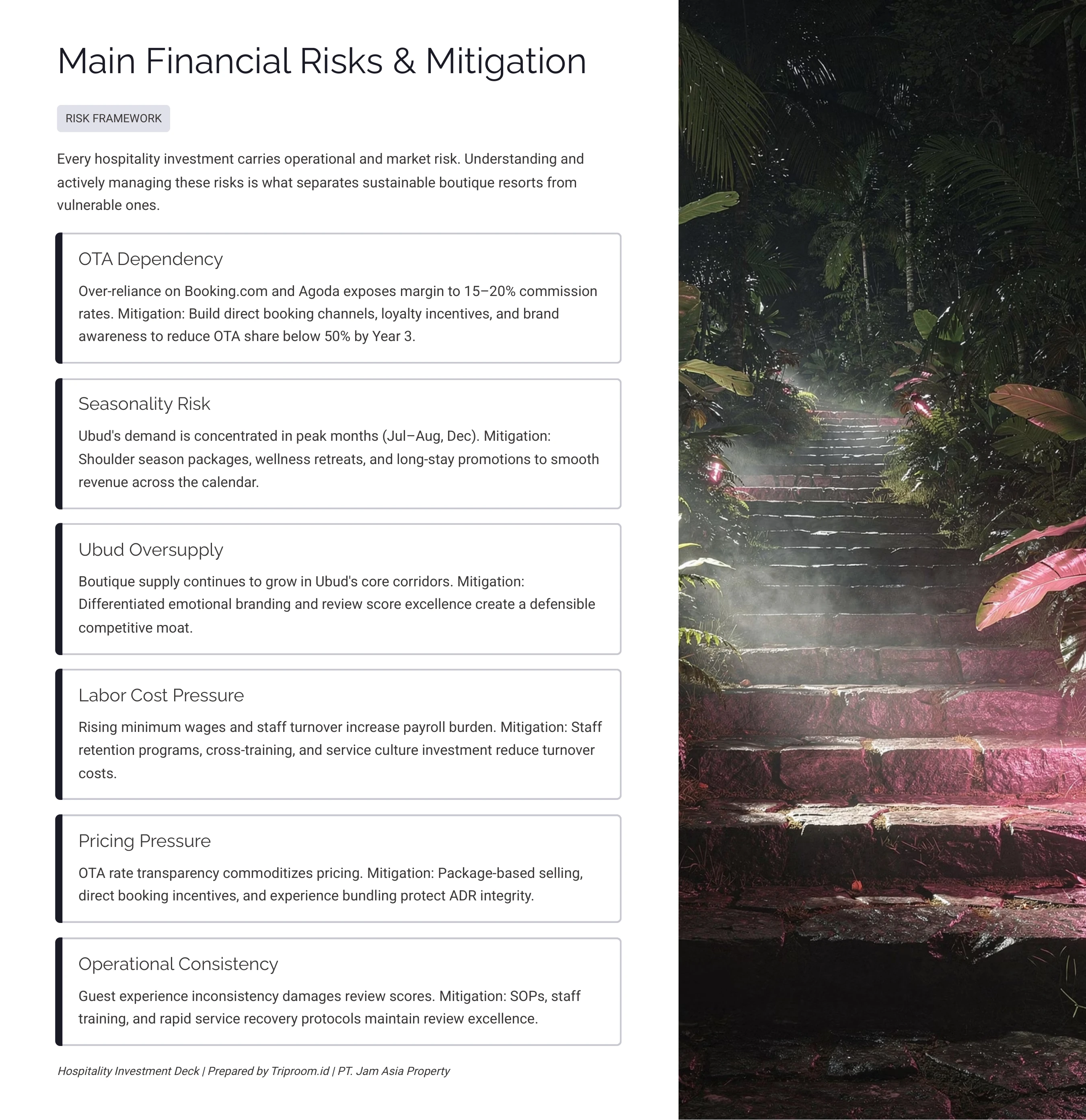
Ashoka Tree Resort Ubud — Main Financial Risks and Mitigation: OTA, Seasonality, Oversupply, Labor, Pricing
OTA DependencyOver-reliance on Booking.com and Agoda exposes margin to 15–20% commission rates. Mitigation: Build direct booking channels, loyalty incentives, and brand awareness to reduce OTA share below 50% by Year 3.
Seasonality RiskUbud's demand is concentrated in peak months (Jul–Aug, Dec). Mitigation: Shoulder season packages, wellness retreats, and long-stay promotions to smooth revenue across the calendar.
Ubud OversupplyBoutique supply continues to grow in Ubud's core corridors. Mitigation: Differentiated emotional branding and review score excellence create a defensible competitive moat.
Labor Cost PressureRising minimum wages and staff turnover increase payroll burden. Mitigation: Staff retention programs, cross-training, and service culture investment reduce turnover costs.
Pricing PressureOTA rate transparency commoditizes pricing. Mitigation: Package-based selling, direct booking incentives, and experience bundling protect ADR integrity.
Operational ConsistencyGuest experience inconsistency damages review scores. Mitigation: SOPs, staff training, and rapid service recovery protocols maintain review excellence.

Year 2 Financial Outlook — 2027

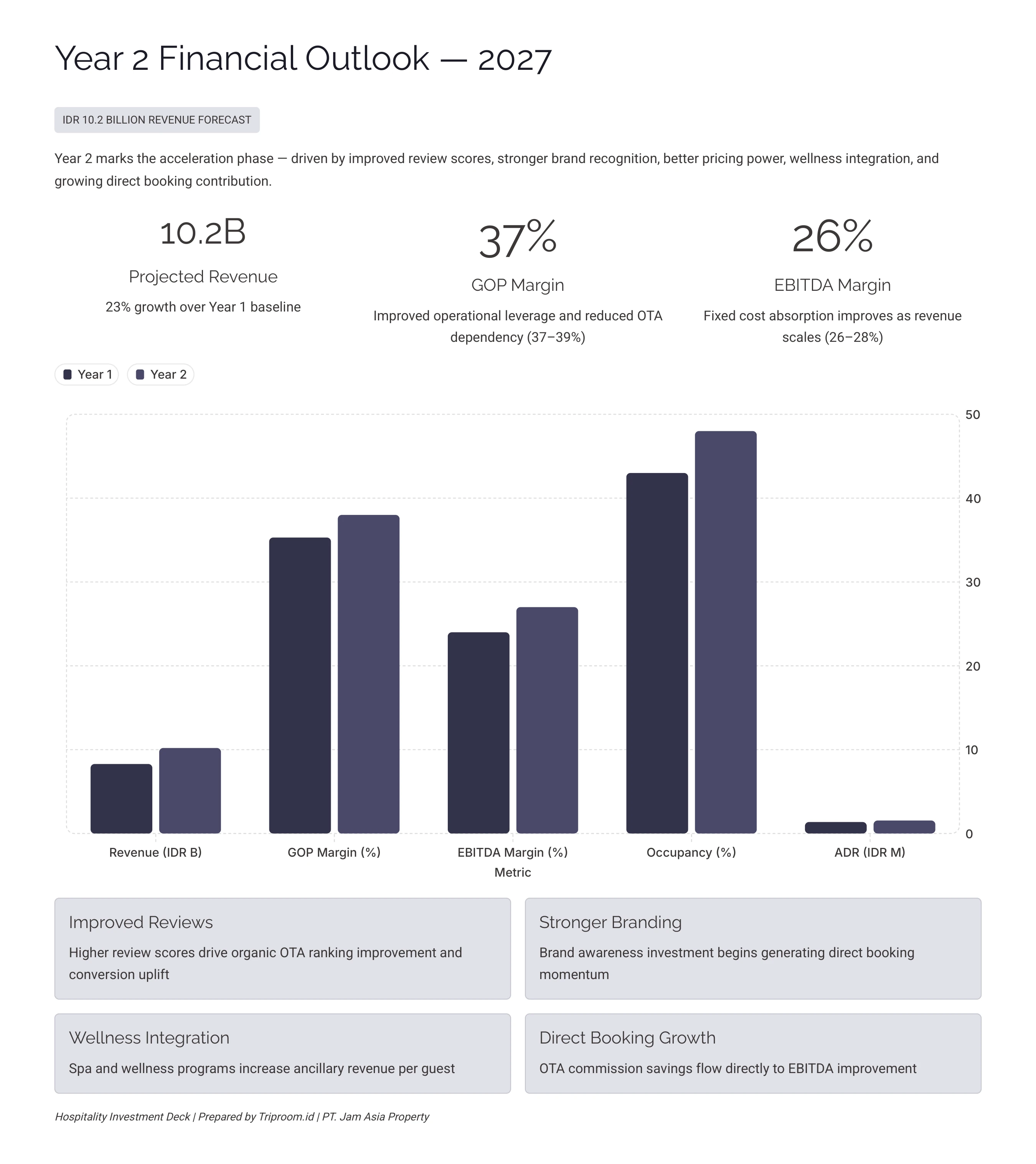
Ashoka Tree Resort Ubud — Year 2 Financial Outlook 2027: IDR 10.2B Revenue, 37% GOP Margin, 26% EBITDA
IDR 10.2BProjected Revenue
37%GOP Margin
26%EBITDA Margin

Year 2 marks the acceleration phase — driven by improved review scores, stronger brand recognition, better pricing power, wellness integration, and growing direct booking contribution.

Improved ReviewsHigher review scores drive organic OTA ranking improvement and conversion uplift
Stronger BrandingBrand awareness investment begins generating direct booking momentum
Wellness IntegrationSpa and wellness programs increase ancillary revenue per guest
Direct Booking GrowthOTA commission savings flow directly to EBITDA improvement

Year 3 Financial Outlook — 2028

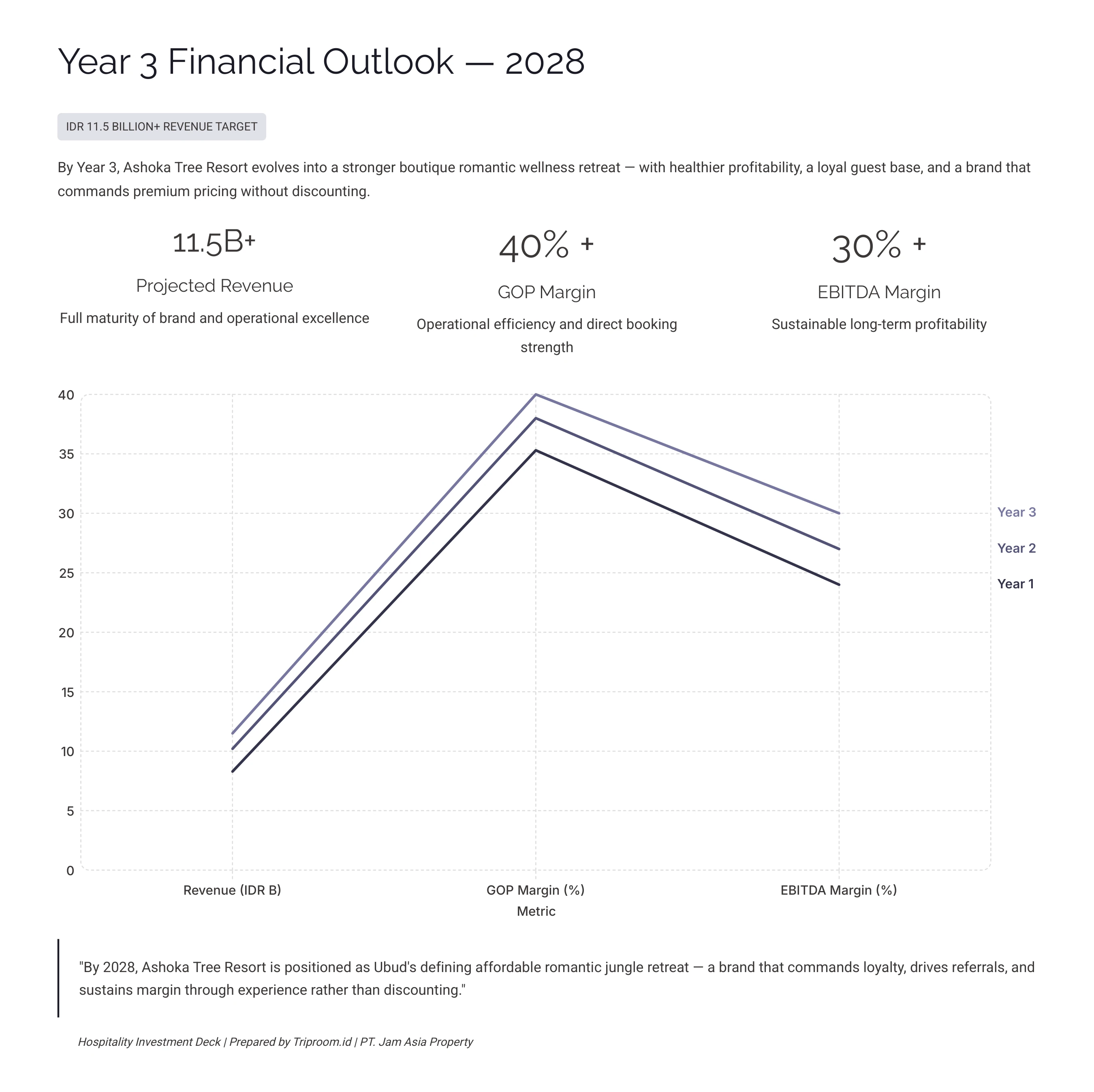
Ashoka Tree Resort Ubud — Year 3 Financial Outlook 2028: IDR 11.5B+ Revenue, 40%+ GOP, 30%+ EBITDA
IDR 11.5B+Projected Revenue
40%+GOP Margin
30%+EBITDA Margin
Year 3 Vision

By 2028, Ashoka Tree Resort is positioned as Ubud's defining affordable romantic jungle retreat — a brand that commands loyalty, drives referrals, and sustains margin through experience rather than discounting.

Boutique Hotel Benchmark Comparison
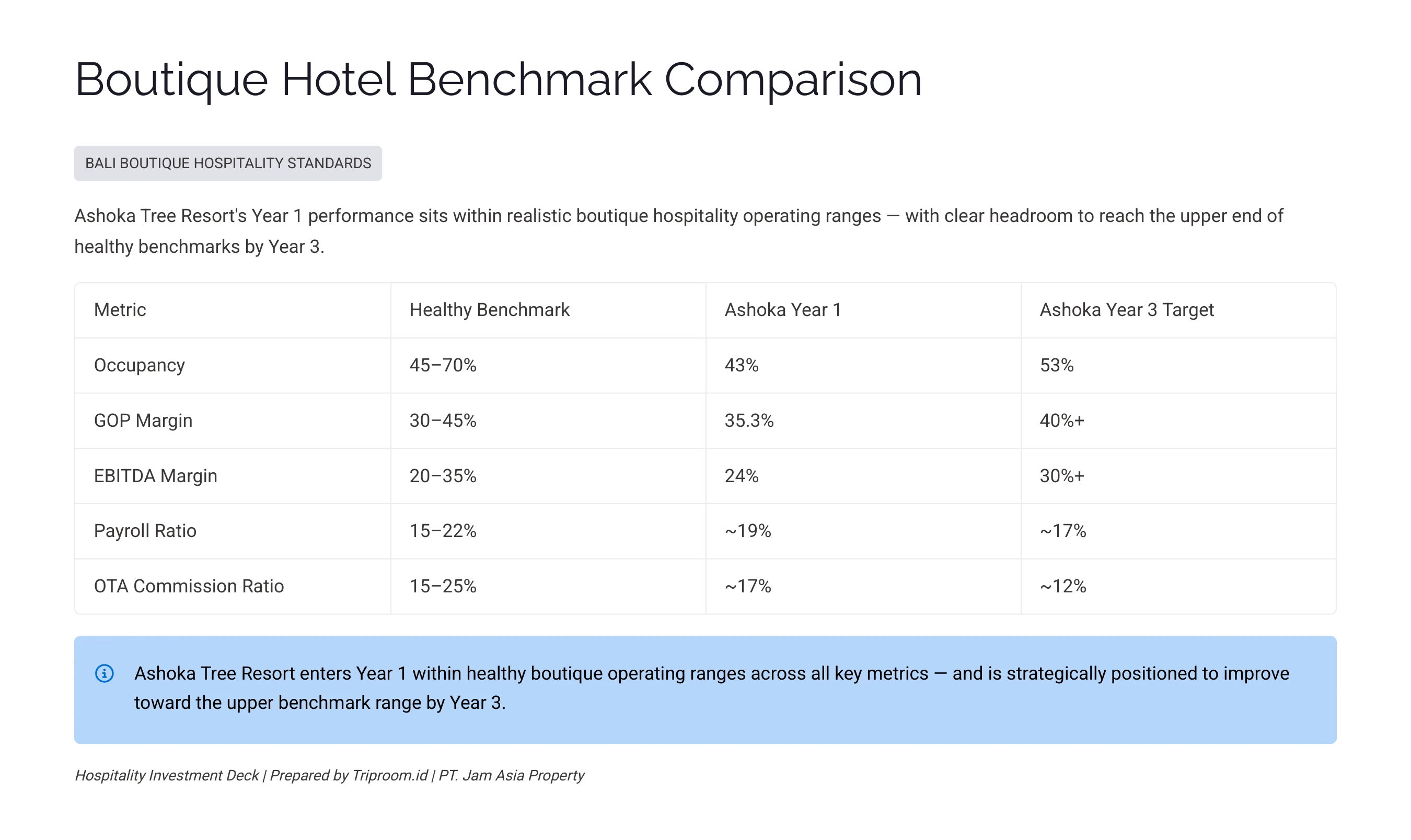
Ashoka Tree Resort Ubud — Boutique Hotel Benchmark Comparison: Bali Boutique Hospitality Standards
MetricOccupancy
Healthy Benchmark45–70%
Ashoka Year 143%
Ashoka Year 3 Target53%
MetricGOP Margin
Healthy Benchmark30–45%
Ashoka Year 135.3%
Ashoka Year 3 Target40%+
MetricEBITDA Margin
Healthy Benchmark20–35%
Ashoka Year 124%
Ashoka Year 3 Target30%+
MetricPayroll Ratio
Healthy Benchmark15–22%
Ashoka Year 1~19%
Ashoka Year 3 Target~17%
MetricOTA Commission Ratio
Healthy Benchmark15–25%
Ashoka Year 1~17%
Ashoka Year 3 Target~12%

Ashoka Tree Resort enters Year 1 within healthy boutique operating ranges across all key metrics — and is strategically positioned to improve toward the upper benchmark range by Year 3.

Future Strategic Direction 2026–2028
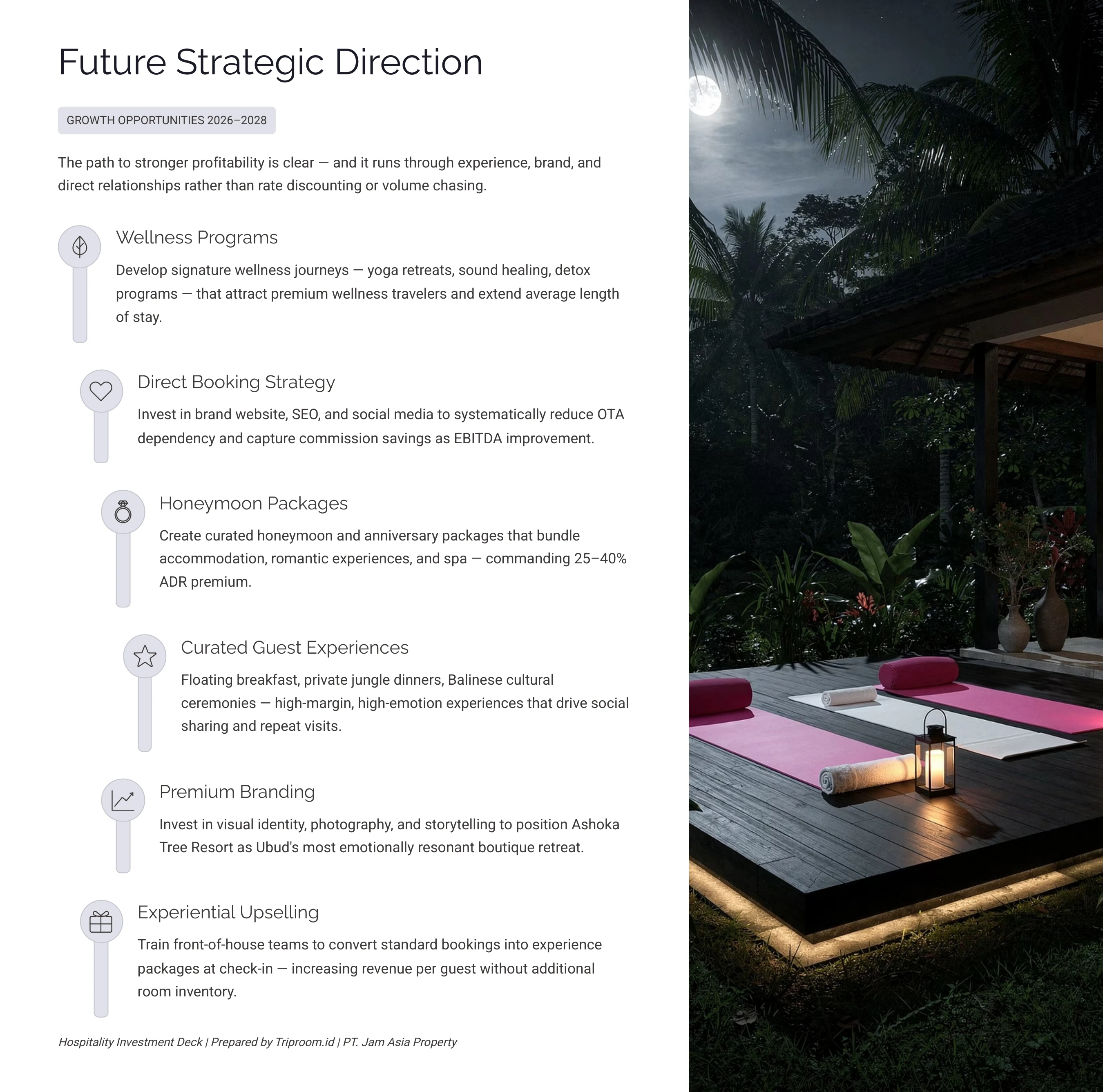
Ashoka Tree Resort Ubud — Future Strategic Direction: Wellness Programs, Direct Booking, Honeymoon Packages, Experiences

The path to stronger profitability is clear — and it runs through experience, brand, and direct relationships rather than rate discounting or volume chasing.

Wellness ProgramsDevelop signature wellness journeys — yoga retreats, sound healing, detox programs — that attract premium wellness travelers and extend average length of stay.
Direct Booking StrategyInvest in brand website, SEO, and social media to systematically reduce OTA dependency and capture commission savings as EBITDA improvement.
Honeymoon PackagesCreate curated honeymoon and anniversary packages that bundle accommodation, romantic experiences, and spa — commanding 25–40% ADR premium.
Curated Guest ExperiencesFloating breakfast, private jungle dinners, Balinese cultural ceremonies — high-margin, high-emotion experiences that drive social sharing and repeat visits.
Premium BrandingInvest in visual identity, photography, and storytelling to position Ashoka Tree Resort as Ubud's most emotionally resonant boutique retreat.
Experiential UpsellingTrain front-of-house teams to convert standard bookings into experience packages at check-in — increasing revenue per guest without additional room inventory.

Ashoka Tree Resort Ubud — Investment Conclusion
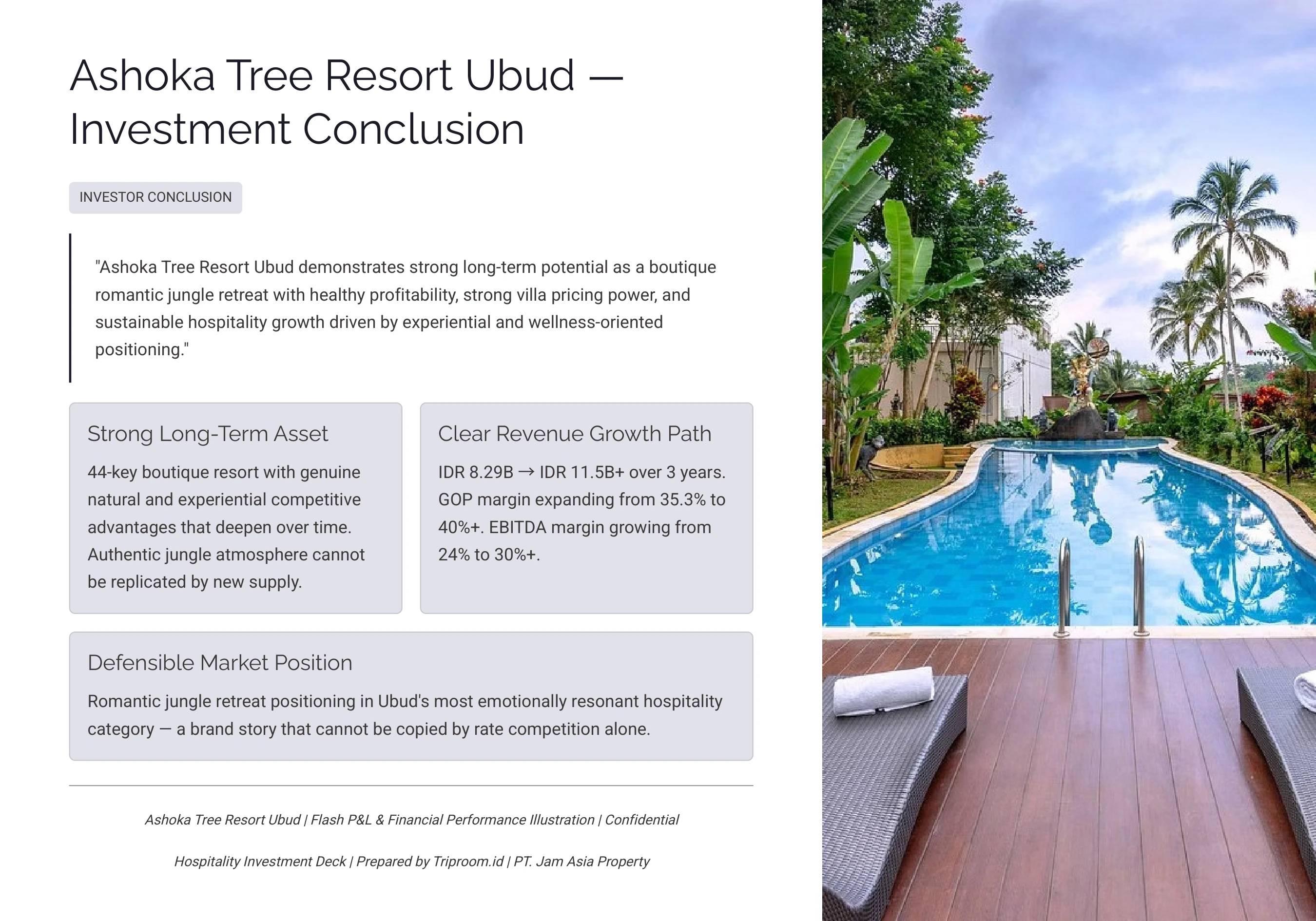
Ashoka Tree Resort Ubud — Investment Conclusion: Strong Long-Term Asset, Clear Revenue Path, Defensible Position
Investment Conclusion

Ashoka Tree Resort Ubud demonstrates strong long-term potential as a boutique romantic jungle retreat with healthy profitability, strong villa pricing power, and sustainable hospitality growth driven by experiential and wellness-oriented positioning.

Strong Long-Term Asset44-key boutique resort with genuine natural and experiential competitive advantages that deepen over time. Authentic jungle atmosphere cannot be replicated by new supply.
Clear Revenue Growth PathIDR 8.29B → IDR 11.5B+ over 3 years. GOP margin expanding from 35.3% to 40%+. EBITDA margin growing from 24% to 30%+.
Defensible Market PositionRomantic jungle retreat positioning in Ubud's most emotionally resonant hospitality category — a brand story that cannot be copied by rate competition alone.

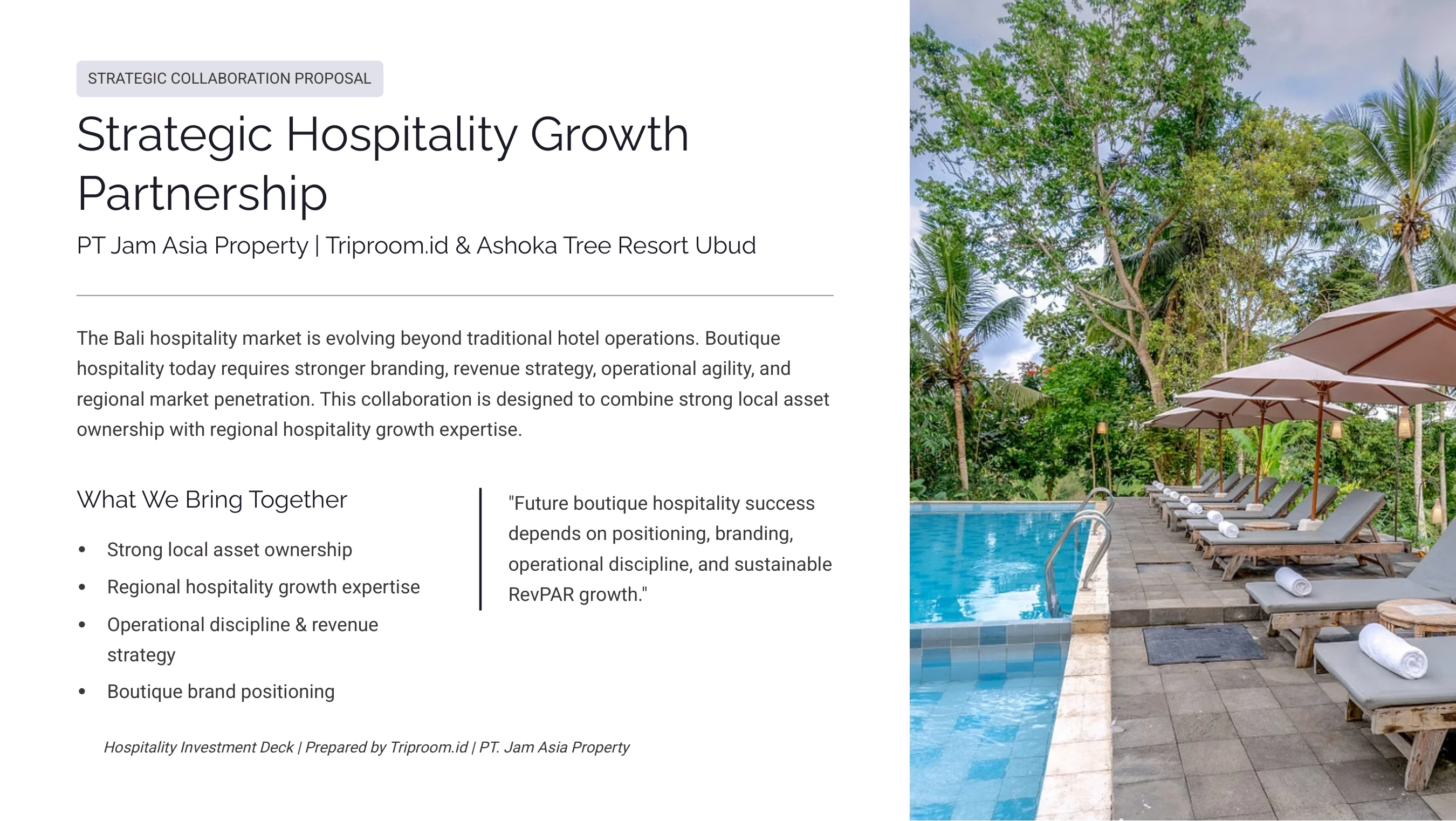
Strategic Collaboration Proposal

Ashoka Tree Resort Ubud — Strategic Hospitality Growth Partnership: PT Jam Asia Property & Ashoka Tree Resort

The Bali hospitality market is evolving beyond traditional hotel operations. Boutique hospitality today requires stronger branding, revenue strategy, operational agility, and regional market penetration. This collaboration is designed to combine strong local asset ownership with regional hospitality growth expertise.

Strong local asset ownershipBoutique brand positioning
Regional hospitality growth expertiseOperational discipline & revenue strategy
Partnership Vision

Future boutique hospitality success depends on positioning, branding, operational discipline, and sustainable RevPAR growth.

Proposed Collaboration Structure
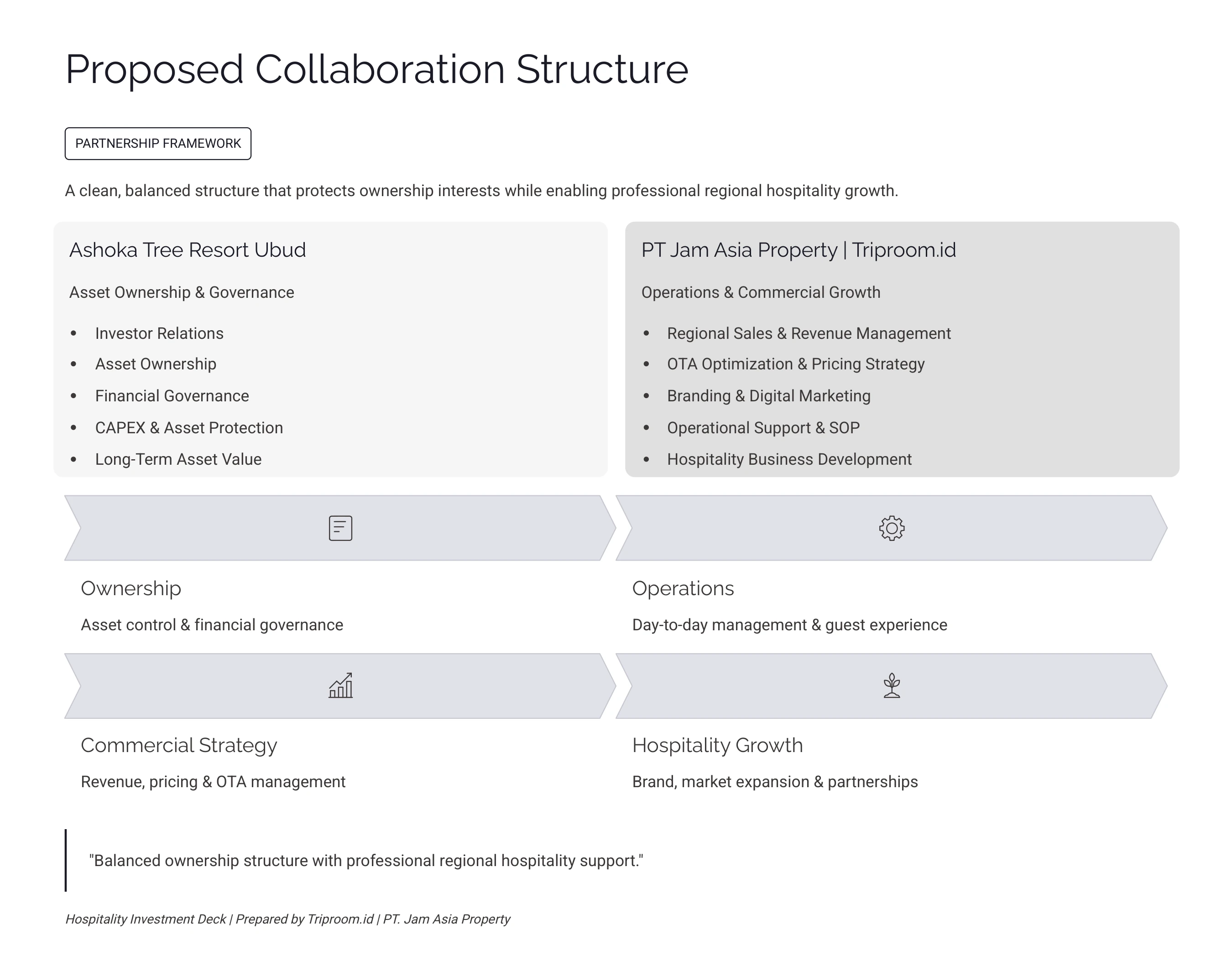
Ashoka Tree Resort Ubud — Proposed Collaboration Structure: Asset Ownership & Operations Partnership Framework

A clean, balanced structure that protects ownership interests while enabling professional regional hospitality growth.

PartyAshoka Tree Resort Ubud
RoleAsset Ownership & Governance
ResponsibilitiesInvestor Relations · Asset Ownership · Financial Governance · CAPEX & Asset Protection · Long-Term Asset Value
PartyPT Jam Asia Property | Triproom.id
RoleOperations & Commercial Growth
ResponsibilitiesRegional Sales & Revenue Management · OTA Optimization & Pricing Strategy · Branding & Digital Marketing · Operational Support & SOP · Hospitality Business Development

Strategic Partnership Value & Fee Structure
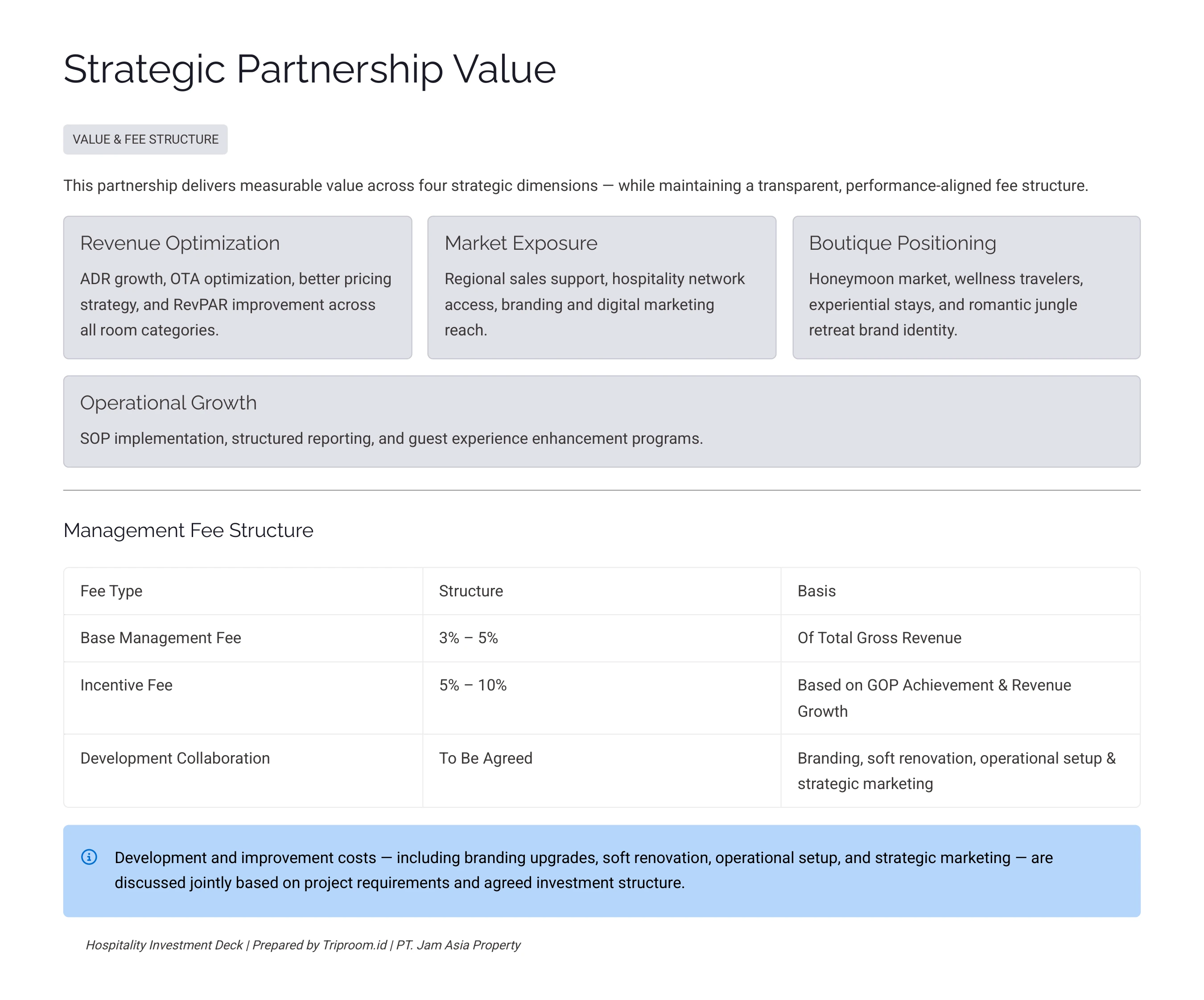
Ashoka Tree Resort Ubud — Strategic Partnership Value: Revenue Optimization, Market Exposure, Boutique Positioning, Operations

This partnership delivers measurable value across four strategic dimensions — while maintaining a transparent, performance-aligned fee structure.

Revenue OptimizationADR growth, OTA optimization, better pricing strategy, and RevPAR improvement across all room categories.
Market ExposureRegional sales support, hospitality network access, branding and digital marketing reach.
Boutique PositioningHoneymoon market, wellness travelers, experiential stays, and romantic jungle retreat brand identity.
Operational GrowthSOP implementation, structured reporting, and guest experience enhancement programs.
Fee TypeBase Management Fee
Structure3% – 5%
BasisOf Total Gross Revenue
Fee TypeIncentive Fee
Structure5% – 10%
BasisBased on GOP Achievement & Revenue Growth
Fee TypeDevelopment Collaboration
StructureTo Be Agreed
BasisBranding, soft renovation, operational setup & strategic marketing

Strategic Hospitality Growth Opportunity Summary
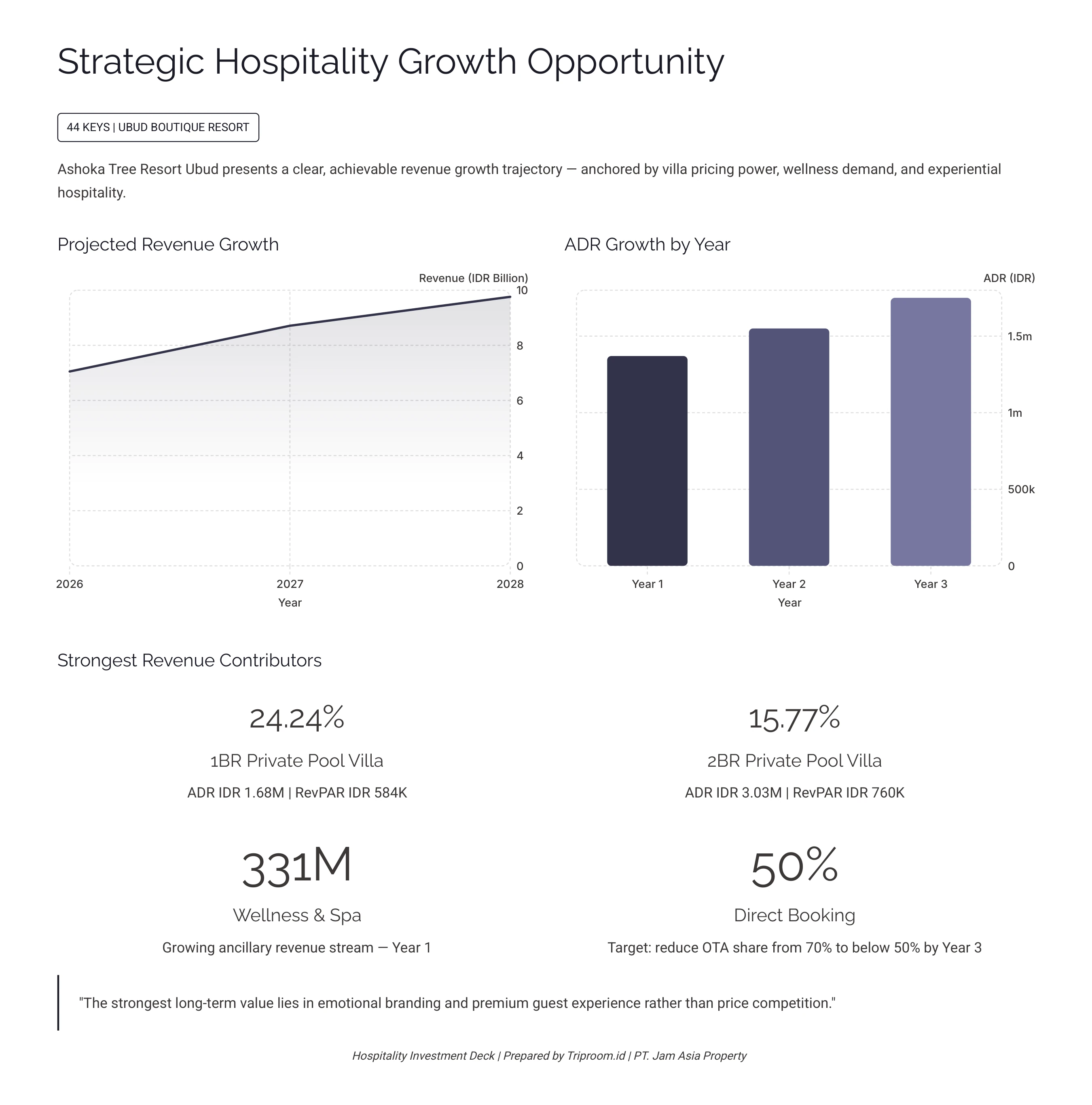
Ashoka Tree Resort Ubud — Strategic Hospitality Growth Opportunity: Revenue Growth, ADR Growth, Villa Contribution

Ashoka Tree Resort Ubud presents a clear, achievable revenue growth trajectory — anchored by villa pricing power, wellness demand, and experiential hospitality.

Revenue Contributor1BR Private Pool Villa
Share / Target24.24% Revenue Share
MetricADR IDR 1.68M | RevPAR IDR 584K
Revenue Contributor2BR Private Pool Villa
Share / Target15.77% Revenue Share
MetricADR IDR 3.03M | RevPAR IDR 760K
Revenue ContributorWellness & Spa
Share / TargetIDR 331M Year 1
MetricGrowing ancillary revenue stream
Revenue ContributorDirect Booking
Share / TargetTarget: below 50% OTA share
MetricReduce from 70% to below 50% by Year 3
Investment Thesis

The strongest long-term value lies in emotional branding and premium guest experience rather than price competition.

Long-Term Strategic Vision: Building Something That Lasts
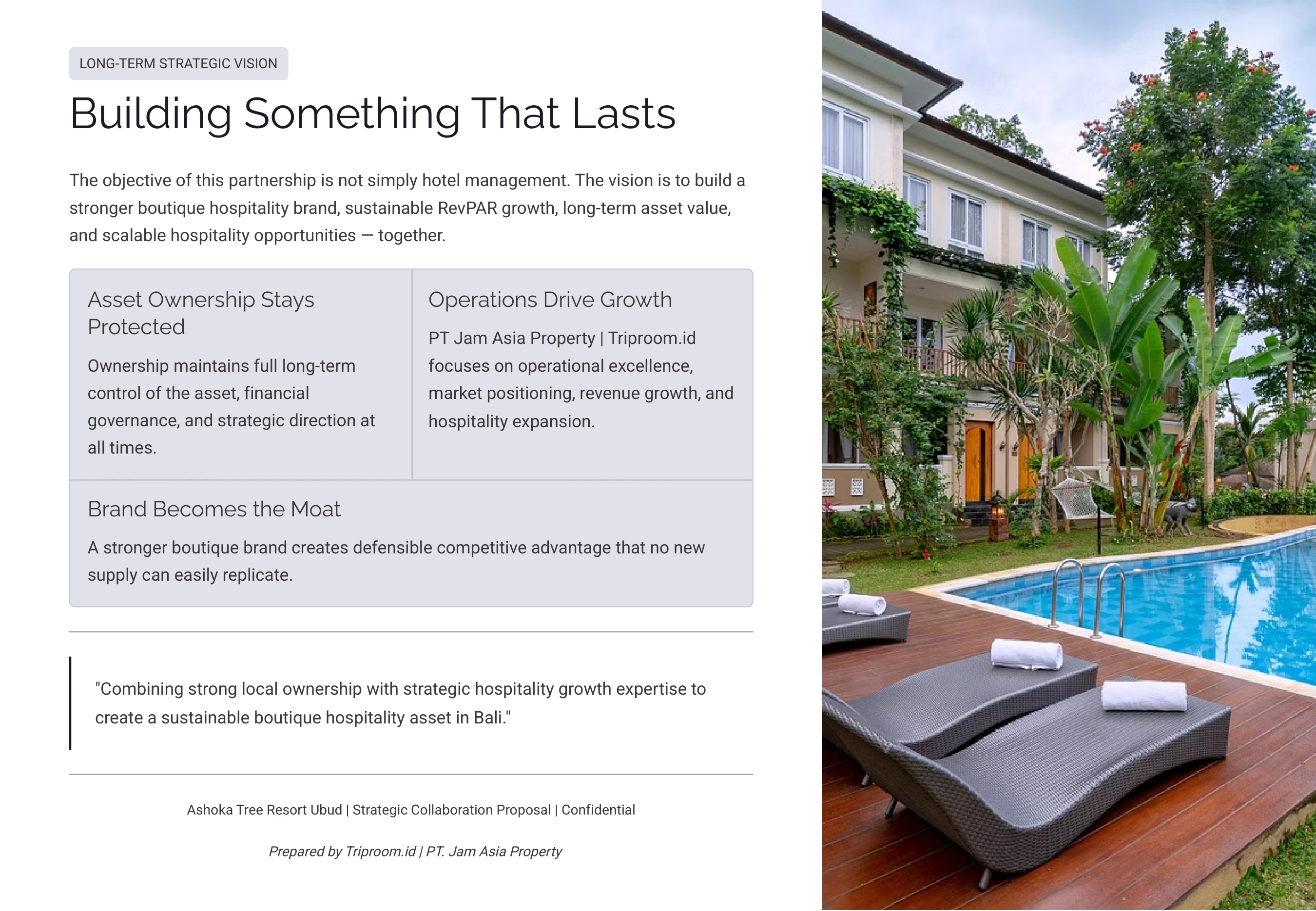
Ashoka Tree Resort Ubud — Long-Term Strategic Vision: Strong Brand, Sustainable RevPAR, Scalable Hospitality

The objective of this partnership is not simply hotel management. The vision is to build a stronger boutique hospitality brand, sustainable RevPAR growth, long-term asset value, and scalable hospitality opportunities — together.

Asset Ownership Stays ProtectedOwnership maintains full long-term control of the asset, financial governance, and strategic direction at all times.
Operations Drive GrowthPT Jam Asia Property | Triproom.id focuses on operational excellence, market positioning, revenue growth, and hospitality expansion.
Brand Becomes the MoatA stronger boutique brand creates defensible competitive advantage that no new supply can easily replicate.
Partnership Conclusion

Combining strong local ownership with strategic hospitality growth expertise to create a sustainable boutique hospitality asset in Bali.

Bekerja Sama

Butuh Mitra Pengembangan di Bali?

Diskusikan dengan tim kami tentang pengembangan vila butik, manajemen hospitality, atau eksekusi proyek untuk investor.

Hubungi Tim Kami
Ashoka Tree Resort Ubud: Strategic Business & Revenue Development Plan 2026–2028
Blog Triproom.id

Editorial

Ashoka Tree Resort Ubud: Strategic Business & Revenue Development Plan 2026–2028

Triproom.id's full strategic business, revenue development, and financial performance plan for Ashoka Tree Resort Ubud — covering market positioning, financial projections, room category performance, ancillary revenue strategy, risk mitigation, and a structured collaboration framework for 2026–2028.

Ashoka Tree Resort Ubud is a 44-key boutique jungle retreat positioned at the intersection of romantic hospitality, wellness travel, and authentic Balinese experience. This Strategic Business & Revenue Development Plan 2026–2028, prepared by Triproom.id | PT. Jam Asia Property, outlines a disciplined path from OTA-dependent volume operator to a direct-booking, experience-led destination brand with IDR 25.53 Billion in projected 3-year revenue.

44 KeysBoutique Jungle Retreat
IDR 25.53B3-Year Projected Revenue
IDR 8.29BYear 1 Gross Revenue
38.4%RevPAR Growth (3-Year)
24%Year 1 EBITDA Margin
35.3%Year 1 GOP Margin

The Landscape Has Changed

Bali is no longer a single, homogeneous hospitality market. Pockets of genuine excellence now coexist alongside undifferentiated supply fighting on price alone. The properties winning today are not necessarily the largest — they are the most precisely positioned, the most emotionally resonant, and the most operationally disciplined.

The Old PlaybookThe New Imperative
Maximize keys. Drive occupancy. Compete on OTA rate. Hope the market lifts all boats.Hospitality success today depends on positioning, branding, guest experience, pricing power, and risk-adjusted revenue growth. Occupancy growth alone is no longer enough.
Market Reality

Growth alone is not enough. In today's Bali market, the properties that survive on volume alone will be crowded out by those that compete on meaning.

The Bali Hospitality Market Shift

Ashoka Tree Resort Ubud — Bali Hospitality Market Shift: Wellness, Romantic, Boutique, Sustainable Tourism

A structural transformation is underway across Bali's hospitality landscape. Travelers are no longer booking a room — they are curating an experience. The rise of wellness tourism, romantically positioned retreats, and emotionally-driven hospitality has fundamentally changed the competitive field.

Market ShiftDescription
Wellness TourismGlobal wellness travel now exceeds $1 trillion annually. Ubud is positioned at its epicenter — yoga retreats, sound healing, and detox programs drive premium, loyalty-rich guests.
Romantic Destination TravelHoneymoon and anniversary travelers command the highest ADR premiums. Emotional storytelling transforms a villa into a once-in-a-lifetime memory.
Boutique Hospitality GrowthIntimate, character-rich properties outperform chain hotels on guest satisfaction and review scores. Smaller scale enables curated, consistent service.
Sustainable TourismEco-conscious travelers increasingly choose properties with authentic environmental and cultural commitments — a growing differentiator that commands both loyalty and premium pricing.
Market Insight

Future winners are not necessarily the biggest hotels — they are the strongest-positioned brands.

Why Ubud Remains a Compelling Market

Structural Demand DriversMarket Risks to Monitor
Wellness tourism demand growing year-over-yearIncreasing supply from undifferentiated boutique properties
Ubud firmly established as Bali's premier honeymoon destinationInfrastructure pressure limiting peak season capacity
Jungle retreat segment showing consistent long-stay demandRising land and development costs compressing margins
Rise of slow travel and remote-work-extended staysOTA pricing pressure eroding direct rate integrity
Boutique resort trend replacing mass-market preference
Experiential tourism replacing transactional accommodation
Strategic Imperative

Competition is intensifying. Positioning clarity is no longer optional — it is the primary defense.

Ashoka Tree Resort: Brand Positioning

Ashoka Tree Resort Ubud — Brand Positioning: Affordable Romantic Jungle Retreat

Ashoka Tree Resort Ubud occupies a carefully defined space in the market: emotionally premium, accessibly priced, and deeply romantic. This is not a compromise position — it is a strategic wedge between luxury-only resorts and undifferentiated budget properties.

Target SegmentProfile
Honeymoon CouplesThe highest-value, highest-loyalty segment. Seek intimacy, privacy, and Instagram-worthy moments in a lush natural setting.
Leisure CouplesAnniversary and romantic escape travelers with strong repeat potential and above-average ancillary spend.
Wellness TravelersYoga practitioners, mindfulness seekers, and detox guests drawn to Ubud's healing energy and jungle sanctuary atmosphere.
Experiential TravelersGuests who choose character and story over amenity lists — they book for the feeling, and they share it widely.

Executive Summary

Ashoka Tree Resort Ubud — Executive Summary: Strategic Overview 2026–2028
44 Keys5 Room Categories
IDR 25.53B3-Year Total Revenue
IDR 671KYear 3 RevPAR Target
38.4%RevPAR Growth 3-Year
Strategic PillarSummary
Business Overview44 keys across five room categories, from Superior Rooms to Two-Bedroom Private Pool Villas. Current positioning: mid-boutique, romantic, jungle-atmosphere resort in Ubud's competitive corridor.
Strategic RepositioningShift from rate-reactive OTA operator to an emotionally branded destination resort with stronger direct booking, higher ADR integrity, and curated guest experience.
Financial Growth OpportunityProjected 3-year total revenue of IDR 25.53 Billion. RevPAR growth from IDR 485K (Year 1) to IDR 671K (Year 3), driven by occupancy gains and ADR expansion.
Long-Term PositioningBy 2028, Ashoka Tree Resort is positioned as Ubud's defining affordable romantic jungle retreat — a brand that commands loyalty, drives referrals, and sustains margin through experience rather than discounting.

SWOT Analysis

Ashoka Tree Resort Ubud — SWOT Analysis: Strengths, Weaknesses, Opportunities, Threats
SWOTDetails
StrengthsJungle atmosphere & natural setting — rare, authentic Ubud immersion. Private pool villas — high perceived value, romantic appeal. Romantic ambiance — strong honeymoon & couples positioning. Competitive pricing vs. luxury comp set — accessible luxury advantage.
WeaknessesOTA dependency — over-reliance on Booking.com & Expedia erodes margin. Low direct booking rate — missed revenue and guest relationship opportunity. Inconsistent branding & visual identity — dilutes premium perception. Reactive pricing strategy — limits ADR growth potential.
OpportunitiesWellness tourism boom — Ubud is a global wellness destination. Honeymoon & romance market growth — high ADR, high loyalty segment. Experiential hospitality demand — guests pay premium for curated moments. Direct booking channel development — OTA margin recovery potential.
ThreatsUbud oversupply risk — new boutique properties entering the market. OTA price war erosion — race-to-bottom rate pressure. Rising operational costs — staff, utilities, F&B cost inflation. Review score sensitivity — one bad review cycle impacts occupancy.

The SWOT reveals a clear strategic path: Ashoka's natural and experiential strengths are genuine and defensible. The primary vulnerabilities — OTA dependency and brand inconsistency — are operational, not structural, and therefore fully addressable within the 2026–2028 plan horizon.

Market Segmentation

Ashoka Tree Resort Ubud — Guest Mix & Market Segmentation: Honeymoon, Leisure Couple, Family, Wellness
SegmentShareStrategic Notes
Honeymoon35%The anchor segment. Highest ADR potential, strongest emotional brand affinity, and most likely to generate organic social content and referrals.
Leisure Couple25%High repeat potential. Strong ancillary spend on romantic dinners, spa, and curated experiences.
Family15%Secondary segment providing volume during school holiday windows.
Wellness10%Growing rapidly. Yoga, sound healing, and detox packages drive longer average stays and reduce OTA exposure.
Domestic Market10%A resilient, lower-seasonality segment providing base occupancy during international off-peak periods.
Retreat Group5%Group bookings for wellness retreats and corporate wellness programs.

Competitive Benchmark Landscape

Ashoka Tree Resort Ubud — Competitive Benchmark Landscape: Ubud Boutique Properties Comparison

Ashoka Tree Resort competes within a defined cluster of Ubud boutique properties. Understanding their positioning reveals both where the market is crowded and where meaningful white space exists.

PropertyADR PositionOTA ReviewEmotional BrandingWellness PositioningRomantic Position
Aventus ResortMid-PremiumStrongModerateModerateStrong
Tjendana KanakaMidModerateModerateLowModerate
Tetirah BoutiqueMid-PremiumStrongStrongStrongStrong
Alam Kawi ResortPremiumVery StrongStrongStrongModerate
Clan LivingMidModerateLowLowLow
Ubud Art ResortMidModerateStrongLowModerate
Meruhdani BoutiqueMidModerateModerateLowModerate
The Lokha UbudPremiumVery StrongVery StrongStrongVery Strong
Ashoka Tree ResortMid (Opportunity)GrowingDevelopingDevelopingStrong Core
Competitive Gap

Ashoka's romantic core strength is underutilized. Closing the branding and wellness gap represents the primary ADR growth lever.

Strategic Market Insights

The boutique hospitality competitive advantage has fundamentally shifted. Rate parity tools have commoditized pricing transparency — the new moat is emotional differentiation.

InsightDetail
1. Emotional StorytellingGuests book with their hearts, justify with logic. Properties that tell a compelling, authentic story convert at higher rates and command loyalty that resists competitor price comparison.
2. Visual Branding & Social ExposureInstagram-worthy moments — floating breakfasts, jungle pool villas, flower-strewn baths — function as organic marketing assets that generate bookings at zero acquisition cost.
3. Wellness IntegrationProperties with credible wellness programming attract a guest profile with higher ADR tolerance, longer stays, and stronger brand affinity. Wellness converts browsers into loyalists.
4. Guest Experience as Pricing PowerProperties with stronger emotional branding consistently command a +15–30% ADR premium versus comparable undifferentiated competitors in the same market.

Property Inventory Overview — 44 Keys

Ashoka Tree Resort Ubud — Property Inventory Overview: 44 Keys Room Category Mix
TierCategoryKeysRole
Standard TierSuperior Room16Volume occupancy engine, entry-price conversion funnel
Standard TierDeluxe Room10Mid-volume, moderate ADR — occupancy stabilizer
Premium TierJunior Suite6Mid-market upsell bridge, ideal for anniversary couples
Villa Tier1BR Private Pool Villa8ADR drivers, honeymoon anchors, revenue crown jewels
Villa Tier2BR Private Pool Villa4Highest ADR, highest margin — portfolio revenue peak

The 44-key portfolio is intentionally intimate — large enough to achieve operational efficiency, small enough to deliver personalized service at every touchpoint. Villa Tier (12 keys, 27% of inventory) generates 40% of total Year 1 revenue, making it the single greatest revenue growth lever in the portfolio.

3-Year Financial Projection Overview

Ashoka Tree Resort Ubud — 3-Year Financial Projection: Revenue IDR 25.5B, RevPAR Growth 2026–2028
IDR 25.5B3-Year Total Revenue
51%Year 3 Occupancy Target
IDR 1.61MYear 3 ADR
IDR 671KYear 3 RevPAR
YearRevenueKey Metric
Year 1 (2026)IDR 8.29B43% occupancy, IDR 485K RevPAR — operational baseline
Year 2 (2027)IDR 10.2B23% growth over Year 1 — brand momentum & review improvement
Year 3 (2028)IDR 11.5B+51% occupancy, IDR 671K RevPAR — brand and operational maturity

ADR & Occupancy Trend

Ashoka Tree Resort Ubud — ADR and Occupancy Trend Chart 2026–2028: RevPAR 38.4% Growth

The financial trajectory reflects a deliberate dual-engine strategy: occupancy gains driven by improved distribution and brand awareness, paired with ADR growth powered by stronger positioning, better guest experience, and reduced discounting pressure. RevPAR — the combined measure of both — grows 38.4% over the three-year period, from IDR 485K to IDR 671K.

Revenue Contribution by Room Category

Ashoka Tree Resort Ubud — Revenue Contribution by Room Category: Year 1–3 RevPAR by Category
CategoryADROccupancyRevenue Share
Superior RoomIDR 538K62%27.98%
Deluxe RoomIDR 738K58%22.27%
Junior SuiteIDR 838K37%9.74%
1BR Pool VillaIDR 1.68M35%24.24%
2BR Pool VillaIDR 3.03M25%15.77%
Revenue Architecture Insight

The two villa categories — just 12 keys, or 27% of inventory — generate 40% of total Year 1 revenue. Their occupancy remains below full potential, making them the single greatest revenue growth lever in the portfolio. Every 5% occupancy gain in the villa tier adds disproportionate revenue impact versus equivalent gains in standard rooms.

Strategic Financial Insights — Revenue Crown Jewels

One Bedroom Private Pool Villa

At IDR 1.68M ADR with a 35% Year 1 occupancy, the 1BR villa is significantly underoccupied relative to its emotional and pricing potential. Targeted honeymoon marketing and wellness package bundling can move occupancy to 41% by Year 3 — adding substantial RevPAR uplift.

Two Bedroom Private Pool Villa

The 2BR villa commands IDR 3.03M ADR in Year 1, rising to IDR 3.57M by Year 3. With only 4 keys, even modest occupancy improvements create outsized revenue impact. The 2BR villa is the portfolio's highest-leverage, highest-margin asset.

The strategic case is clear: villa tier pricing power, emotional appeal to honeymooners, and upselling potential from standard room bookers creates a revenue flywheel. The villas don't just generate revenue — they anchor the brand's romantic premium positioning across every touchpoint.

RevPAR: The Profitability Indicator That Matters

Revenue Per Available Room is the hospitality industry's most powerful single metric because it cannot be gamed by discounting. A hotel can inflate occupancy by slashing rates — but RevPAR reveals the truth. It captures both pricing integrity and operational fill efficiency in a single number.

IDR 485KYear 1 RevPAR (2026)
IDR 598KYear 2 RevPAR (2027)
IDR 671KYear 3 RevPAR (2028)

Ashoka Tree Resort's RevPAR growth of +38.4% over three years reflects a property gaining both pricing confidence and market share simultaneously — the hallmark of a well-executed repositioning strategy. This trajectory is achievable without major capital expenditure, driven primarily by branding, distribution optimization, and experience enhancement.

Peak Season Performance

Ashoka Tree Resort Ubud — Peak Season ADR Index by Month: July–August, September, December Peaks

Ubud's peak demand calendar creates concentrated windows of premium pricing opportunity. The strategic imperative is to maximize ADR — not just fill rooms — during these high-demand periods, while using shoulder periods to build brand loyalty and direct booking relationships.

Peak PeriodADR IndexStrategy
July – August135–140European summer holiday peak. Highest international arrivals. Maximum ADR window — villas should be rate-protected and not discounted.
September125Shoulder peak with strong honeymoon and wellness traveler demand. Excellent upselling conditions for experiential packages.
October–November90–100Shoulder period — focus on domestic market activation and loyalty programs.
December130Year-end holiday peak. Strong domestic and international leisure couple demand. Romantic package conversion rates highest of the year.

Financial Risks & Mitigation Strategy

Ashoka Tree Resort Ubud — Financial Risks and Mitigation Strategy Framework
RiskMitigation
OTA Dependency RiskOver-reliance on Booking.com and Agoda exposes margin to commission rates of 15–20% per booking. Mitigation: Systematic direct booking channel development, loyalty incentives, and brand awareness investment to reduce OTA contribution from an estimated 70%+ to below 50% by Year 3.
Ubud Oversupply RiskBoutique supply continues to grow in Ubud's core hospitality corridors. Mitigation: Differentiated emotional branding, review score excellence, and a clearly defined romantic positioning create a defensible competitive moat that generic new entrants cannot easily replicate.
Margin PressureRising labor, F&B, and utility costs squeeze operational margins. Mitigation: Ancillary revenue development (spa, experiences, packages) increases revenue per guest without proportional cost increases, protecting EBITDA margin.
Review Score SensitivityIn a boutique market, a 0.2-point drop in OTA review score can materially reduce booking conversion. Mitigation: Systematic guest feedback programs, staff training, and rapid service recovery protocols maintain review excellence as a structural priority.

Ancillary Revenue Opportunities

Ashoka Tree Resort Ubud — Ancillary Revenue: Spa, Floating Breakfast, Yoga, Romantic Experiences

The guest experience economy represents Ashoka Tree Resort's most accessible near-term revenue opportunity. Curated experiential offerings convert one-time visitors into loyal brand advocates while adding 15–30% incremental revenue per guest stay without requiring additional room inventory.

ExperienceRevenue Potential
Spa & WellnessIn-villa treatments, traditional Balinese massage, and curated wellness journeys. High-margin, high-satisfaction revenue stream.
Floating BreakfastThe single most-shared social moment in Bali hospitality. Functions simultaneously as premium ancillary revenue and organic marketing content.
Yoga & Sound HealingMorning yoga sessions and traditional sound healing ceremonies connect guests to Ubud's spiritual identity and extend average length of stay.
Romantic ExperiencesPrivate dinners, flower decoration packages, and anniversary setups create high-emotion, low-cost moments that justify premium package pricing.

Strategic Priorities Roadmap 2026–2028

Ashoka Tree Resort Ubud — Strategic Priorities Roadmap: Phase 1 Foundation, Phase 2 Experience, Phase 3 Brand Equity
PhaseTimelineFocus Areas
Phase 1: Foundation0–6 MonthsOTA listing optimization · professional photography · review response strategy · honeymoon package creation · floating breakfast launch
Phase 2: Experience6–12 MonthsWellness program integration · soft renovation of public spaces · consistent brand visual identity · improved guest flow and arrival experience
Phase 3: Brand Equity12–24 MonthsDirect booking growth engine · repeat guest loyalty program · reduced OTA commission exposure · sustained ADR premium versus comp set

Year-by-Year Room Category Performance

Ashoka Tree Resort Ubud — Year-by-Year Room Category Performance: ADR, Occupancy, RevPAR by Category

The following table presents the complete multi-year performance outlook by room category — the operational foundation of the 3-year financial projection.

CategoryYearADROccupancyRevPARRev Contribution
Superior RoomY1IDR 538K62%IDR 337K27.98%
Superior RoomY2IDR 598K69%IDR 416K
Superior RoomY3IDR 633K73%IDR 466K
1BR Pool VillaY1IDR 1.68M35%IDR 584K24.24%
1BR Pool VillaY2IDR 1.87M38%IDR 721K
1BR Pool VillaY3IDR 1.98M41%IDR 809K
2BR Pool VillaY1IDR 3.03M25%IDR 760K15.77%
2BR Pool VillaY2IDR 3.37M28%IDR 939K
2BR Pool VillaY3IDR 3.57M29%IDR 1.05M

Villa RevPAR grows from IDR 760K to IDR 1.05M for the 2BR category — a 38% uplift over three years, driven almost entirely by ADR strength rather than occupancy pressure.

The Future of Bali Hospitality

Future DirectionInsight
Emotionally Branded ResortsProperties with a clear emotional identity command loyalty that is nearly impossible for competitors to buy away with discounts.
Experiential HospitalityEvery curated moment — from arrival to departure — is a retention tool, a marketing asset, and a revenue opportunity simultaneously.
Boutique Wellness RetreatsThe intersection of jungle sanctuary, mindfulness programming, and romantic intimacy defines the highest-growth segment in Bali's evolving hospitality landscape.
Differentiated Guest ExperiencesThe properties that survive the next decade will compete on meaning, not price. Ubud rewards those who invest in depth of experience over breadth of inventory.

Closing Vision — Strategic Plan

Ashoka Tree Resort Ubud — Closing Vision: Strategic Business Plan Investor Conclusion
Investor Conclusion

Ashoka Tree Resort Ubud carries the rare combination of authentic natural beauty, romantic positioning, and operational upside. The path forward is not about building bigger — it is about becoming unforgettable.

The 2026–2028 Strategic Plan charts a clear, achievable trajectory: from a well-located boutique property with underutilized brand equity to Ubud's defining affordable romantic jungle retreat. Through strategic repositioning, emotional branding, wellness integration, and sustainable hospitality management, Ashoka Tree Resort has the foundations to evolve into a profitable, loyalty-rich destination that generates returns on experience as much as returns on capital.

Strategic PillarDetail
Strong Long-Term Asset44-key boutique resort with genuine natural and experiential competitive advantages that deepen, not diminish, over time.
Clear Revenue Growth PathIDR 25.53 Billion in projected 3-year revenue, anchored by villa tier pricing power and experience-driven ancillary growth.
Defensible Market PositionRomantic jungle retreat positioning in Ubud's most emotionally resonant hospitality category — a brand story that cannot be copied by new supply alone.

Flash P&L & Financial Performance Illustration

Ashoka Tree Resort Ubud — Flash P&L and Financial Performance Illustration Cover

The following section presents the boutique hospitality financial overview and strategic profitability analysis for Ashoka Tree Resort Ubud, prepared by Triproom.id | PT. Jam Asia Property.

The New Measure of Hospitality Success

The Old MetricThe New Performance Standard
Fill rooms. Drive occupancy. Compete on OTA rate. Hope the market lifts all boats.Sustainable RevPAR growth. Emotional brand equity. Direct booking strength. Experiential revenue. Operational discipline.
Performance Standard

Strong hospitality assets are built through sustainable RevPAR growth, not occupancy alone.

Property Overview — 44 Keys

Ashoka Tree Resort Ubud — Property Overview: 44 Keys Room Mix by Category

Ashoka Tree Resort Ubud is a 44-key boutique jungle retreat positioned at the intersection of romantic hospitality, wellness travel, and authentic Balinese experience.

PositioningDescription
Boutique Jungle Retreat44 keys, intimate scale, personalized service
Romantic & Wellness FocusHoneymoon couples, anniversary travelers, wellness seekers
Ubud's Affordable LuxuryEmotionally premium, accessibly priced, deeply romantic

Year 1 Operational Summary — 2026 Baseline

Ashoka Tree Resort Ubud — Year 1 Operational Summary: 43% Occupancy, IDR 1.37M ADR, IDR 7.05B Revenue

Year 1 establishes the operational baseline — a 43% occupancy rate with an ADR of IDR 1.37M, generating IDR 7.05 Billion in room revenue across 7,952 sold room nights.

43%Average Occupancy
IDR 1.37MAverage ADR
IDR 485KRevPAR
7,952Sold Room Nights
IDR 7.05BTotal Room Revenue

Total Revenue Composition — Year 1

Ashoka Tree Resort Ubud — Total Revenue Composition Year 1: IDR 8.29B Gross Revenue by Department

Beyond room revenue, Ashoka Tree Resort generates meaningful ancillary income from F&B, spa, romantic experiences, and tours — building a diversified hospitality revenue base.

Revenue StreamAmountShare
Room RevenueIDR 7.05B85.03%
F&B RevenueIDR 414M4.99%
Spa & WellnessIDR 331M3.99%
Romantic Dinner & UpsellingIDR 248M2.99%
Transfer / Tour / OthersIDR 248M2.99%
Total Gross RevenueIDR 8.29B100%

Departmental Operating Expenses — Year 1

Ashoka Tree Resort Ubud — Departmental Operating Expenses Year 1: IDR 5.36B Total OpEx Breakdown

A disciplined cost structure is the foundation of sustainable hospitality profitability. OTA Commission (IDR 1.41B) and Payroll (IDR 1.57B) represent the two largest cost centers — together accounting for ~56% of total operating expenses. Reducing OTA dependency is a key strategic lever.

Expense CategoryNotes
Payroll & Staff CostIDR 1.57B — largest single expense; reducing turnover a key margin lever
OTA CommissionIDR 1.41B — ~17% of revenue; target reduction to ~12% by Year 3
Admin & GeneralOverhead management and administrative operations
Sales & MarketingOTA listing optimization and brand awareness investment
Repairs & MaintenanceProperty upkeep and preventive maintenance program
UtilitiesElectricity, water, and operational utilities
Housekeeping & LaundryRoom servicing and linen management
Guest Supplies & AmenitiesIn-room amenities and guest experience supplies
Spa Operational CostTherapist fees, products, and spa operations
Cost of F&BRaw materials and food & beverage cost of goods
IDR 5.36BTotal Operating Expenses

Gross Operating Profit — Year 1

Ashoka Tree Resort Ubud — Gross Operating Profit Year 1: IDR 2.93B GOP, 35.3% Margin
IDR 8.29BGross Revenue
IDR 5.36BOperating Expenses
IDR 2.93BGross Operating Profit
35.3%GOP Margin
GOP Analysis

A 35.3% GOP margin positions Ashoka Tree Resort within the healthy operating range for boutique hospitality assets in Bali — with clear upside as direct bookings grow and OTA dependency reduces.

EBITDA Illustration — Year 1

Ashoka Tree Resort Ubud — EBITDA Illustration Year 1: IDR 1.98B EBITDA, 24% Margin

After accounting for fixed charges, Ashoka Tree Resort delivers an EBITDA of IDR 1.98 Billion — a 24% margin that reflects the property's genuine operational profitability.

Fixed Charges ComponentAmount
Management FeeIDR 414M
Property InsuranceIDR 82M
Property TaxIDR 124M
FF&E ReserveIDR 248M
MiscellaneousIDR 83M
Total Fixed ChargesIDR 951M
IDR 2.93BGOP (Gross Operating Profit)
IDR 951MTotal Fixed Charges
IDR 1.98BEBITDA
24%EBITDA Margin

An EBITDA margin of 24% is a strong result for a boutique Bali resort at this stage of its growth cycle — with meaningful upside as occupancy and ADR improve in Years 2 and 3.

Villa Revenue — The Profitability Crown Jewels

Ashoka Tree Resort Ubud — Villa Revenue Crown Jewels: 1BR and 2BR Private Pool Villa ADR by Category

Private pool villas are the highest-performing assets in the portfolio — generating disproportionate revenue contribution relative to their key count, driven by superior pricing power and guest willingness to pay for privacy and romance.

Villa CategoryRevenue ShareADRRevPARKeys
1BR Private Pool Villa24.24%IDR 1.68MIDR 584K8
2BR Private Pool Villa15.77%IDR 3.03MIDR 760K4
Villa Thesis

Villa products generate the strongest pricing power and profitability — the strategic case for protecting villa ADR integrity is clear.

Where the Real Revenue Lives

Ashoka Tree Resort Ubud — Where the Real Revenue Lives: Romantic Positioning, Wellness, Experiential Revenue, Direct Booking

The strongest hospitality revenue today is not generated by discounting strategy — it is built through emotional guest experience, romantic positioning, wellness integration, and experiential hospitality.

Revenue DriverImpact
Romantic PositioningHoneymoon and anniversary guests pay a premium for emotional resonance. Romance packages command 20–35% ADR uplift over standard room rates.
Wellness IntegrationSpa, yoga, and sound healing programs extend average length of stay and increase total guest spend per visit.
Experiential RevenueFloating breakfast, private dinners, and curated cultural experiences generate high-margin ancillary income with strong social sharing value.
Direct Booking PowerEvery 10% shift from OTA to direct booking saves approximately IDR 141M in commission costs annually — directly improving EBITDA.
Strategic Truth

The properties that win in Bali's next chapter will not be the cheapest — they will be the most emotionally unforgettable.

Main Financial Risks & Mitigation

Ashoka Tree Resort Ubud — Main Financial Risks and Mitigation: OTA, Seasonality, Oversupply, Labor, Pricing
RiskMitigation
OTA DependencyOver-reliance on Booking.com and Agoda exposes margin to 15–20% commission rates. Mitigation: Build direct booking channels, loyalty incentives, and brand awareness to reduce OTA share below 50% by Year 3.
Seasonality RiskUbud's demand is concentrated in peak months (Jul–Aug, Dec). Mitigation: Shoulder season packages, wellness retreats, and long-stay promotions to smooth revenue across the calendar.
Ubud OversupplyBoutique supply continues to grow in Ubud's core corridors. Mitigation: Differentiated emotional branding and review score excellence create a defensible competitive moat.
Labor Cost PressureRising minimum wages and staff turnover increase payroll burden. Mitigation: Staff retention programs, cross-training, and service culture investment reduce turnover costs.
Pricing PressureOTA rate transparency commoditizes pricing. Mitigation: Package-based selling, direct booking incentives, and experience bundling protect ADR integrity.
Operational ConsistencyGuest experience inconsistency damages review scores. Mitigation: SOPs, staff training, and rapid service recovery protocols maintain review excellence.

Year 2 Financial Outlook — 2027

Ashoka Tree Resort Ubud — Year 2 Financial Outlook 2027: IDR 10.2B Revenue, 37% GOP Margin, 26% EBITDA
IDR 10.2BProjected Revenue
37%GOP Margin
26%EBITDA Margin

Year 2 marks the acceleration phase — driven by improved review scores, stronger brand recognition, better pricing power, wellness integration, and growing direct booking contribution.

Year 2 Growth DriverImpact
Improved ReviewsHigher review scores drive organic OTA ranking improvement and conversion uplift
Stronger BrandingBrand awareness investment begins generating direct booking momentum
Wellness IntegrationSpa and wellness programs increase ancillary revenue per guest
Direct Booking GrowthOTA commission savings flow directly to EBITDA improvement

Year 3 Financial Outlook — 2028

Ashoka Tree Resort Ubud — Year 3 Financial Outlook 2028: IDR 11.5B+ Revenue, 40%+ GOP, 30%+ EBITDA
IDR 11.5B+Projected Revenue
40%+GOP Margin
30%+EBITDA Margin
Year 3 Vision

By 2028, Ashoka Tree Resort is positioned as Ubud's defining affordable romantic jungle retreat — a brand that commands loyalty, drives referrals, and sustains margin through experience rather than discounting.

Boutique Hotel Benchmark Comparison

Ashoka Tree Resort Ubud — Boutique Hotel Benchmark Comparison: Bali Boutique Hospitality Standards
MetricHealthy BenchmarkAshoka Year 1Ashoka Year 3 Target
Occupancy45–70%43%53%
GOP Margin30–45%35.3%40%+
EBITDA Margin20–35%24%30%+
Payroll Ratio15–22%~19%~17%
OTA Commission Ratio15–25%~17%~12%

Ashoka Tree Resort enters Year 1 within healthy boutique operating ranges across all key metrics — and is strategically positioned to improve toward the upper benchmark range by Year 3.

Future Strategic Direction 2026–2028

Ashoka Tree Resort Ubud — Future Strategic Direction: Wellness Programs, Direct Booking, Honeymoon Packages, Experiences

The path to stronger profitability is clear — and it runs through experience, brand, and direct relationships rather than rate discounting or volume chasing.

Strategic InitiativeDetail
Wellness ProgramsDevelop signature wellness journeys — yoga retreats, sound healing, detox programs — that attract premium wellness travelers and extend average length of stay.
Direct Booking StrategyInvest in brand website, SEO, and social media to systematically reduce OTA dependency and capture commission savings as EBITDA improvement.
Honeymoon PackagesCreate curated honeymoon and anniversary packages that bundle accommodation, romantic experiences, and spa — commanding 25–40% ADR premium.
Curated Guest ExperiencesFloating breakfast, private jungle dinners, Balinese cultural ceremonies — high-margin, high-emotion experiences that drive social sharing and repeat visits.
Premium BrandingInvest in visual identity, photography, and storytelling to position Ashoka Tree Resort as Ubud's most emotionally resonant boutique retreat.
Experiential UpsellingTrain front-of-house teams to convert standard bookings into experience packages at check-in — increasing revenue per guest without additional room inventory.

Ashoka Tree Resort Ubud — Investment Conclusion

Ashoka Tree Resort Ubud — Investment Conclusion: Strong Long-Term Asset, Clear Revenue Path, Defensible Position
Investment Conclusion

Ashoka Tree Resort Ubud demonstrates strong long-term potential as a boutique romantic jungle retreat with healthy profitability, strong villa pricing power, and sustainable hospitality growth driven by experiential and wellness-oriented positioning.

Investment PillarDetail
Strong Long-Term Asset44-key boutique resort with genuine natural and experiential competitive advantages that deepen over time. Authentic jungle atmosphere cannot be replicated by new supply.
Clear Revenue Growth PathIDR 8.29B → IDR 11.5B+ over 3 years. GOP margin expanding from 35.3% to 40%+. EBITDA margin growing from 24% to 30%+.
Defensible Market PositionRomantic jungle retreat positioning in Ubud's most emotionally resonant hospitality category — a brand story that cannot be copied by rate competition alone.

Strategic Collaboration Proposal

Ashoka Tree Resort Ubud — Strategic Hospitality Growth Partnership: PT Jam Asia Property & Ashoka Tree Resort

The Bali hospitality market is evolving beyond traditional hotel operations. Boutique hospitality today requires stronger branding, revenue strategy, operational agility, and regional market penetration. This collaboration is designed to combine strong local asset ownership with regional hospitality growth expertise.

What We Bring Together
Strong local asset ownershipBoutique brand positioning
Regional hospitality growth expertiseOperational discipline & revenue strategy
Partnership Vision

Future boutique hospitality success depends on positioning, branding, operational discipline, and sustainable RevPAR growth.

Proposed Collaboration Structure

Ashoka Tree Resort Ubud — Proposed Collaboration Structure: Asset Ownership & Operations Partnership Framework

A clean, balanced structure that protects ownership interests while enabling professional regional hospitality growth.

PartyRoleResponsibilities
Ashoka Tree Resort UbudAsset Ownership & GovernanceInvestor Relations · Asset Ownership · Financial Governance · CAPEX & Asset Protection · Long-Term Asset Value
PT Jam Asia Property | Triproom.idOperations & Commercial GrowthRegional Sales & Revenue Management · OTA Optimization & Pricing Strategy · Branding & Digital Marketing · Operational Support & SOP · Hospitality Business Development

Strategic Partnership Value & Fee Structure

Ashoka Tree Resort Ubud — Strategic Partnership Value: Revenue Optimization, Market Exposure, Boutique Positioning, Operations

This partnership delivers measurable value across four strategic dimensions — while maintaining a transparent, performance-aligned fee structure.

Value DimensionDetail
Revenue OptimizationADR growth, OTA optimization, better pricing strategy, and RevPAR improvement across all room categories.
Market ExposureRegional sales support, hospitality network access, branding and digital marketing reach.
Boutique PositioningHoneymoon market, wellness travelers, experiential stays, and romantic jungle retreat brand identity.
Operational GrowthSOP implementation, structured reporting, and guest experience enhancement programs.
Fee TypeStructureBasis
Base Management Fee3% – 5%Of Total Gross Revenue
Incentive Fee5% – 10%Based on GOP Achievement & Revenue Growth
Development CollaborationTo Be AgreedBranding, soft renovation, operational setup & strategic marketing

Strategic Hospitality Growth Opportunity Summary

Ashoka Tree Resort Ubud — Strategic Hospitality Growth Opportunity: Revenue Growth, ADR Growth, Villa Contribution

Ashoka Tree Resort Ubud presents a clear, achievable revenue growth trajectory — anchored by villa pricing power, wellness demand, and experiential hospitality.

Revenue ContributorShare / TargetMetric
1BR Private Pool Villa24.24% Revenue ShareADR IDR 1.68M | RevPAR IDR 584K
2BR Private Pool Villa15.77% Revenue ShareADR IDR 3.03M | RevPAR IDR 760K
Wellness & SpaIDR 331M Year 1Growing ancillary revenue stream
Direct BookingTarget: below 50% OTA shareReduce from 70% to below 50% by Year 3
Investment Thesis

The strongest long-term value lies in emotional branding and premium guest experience rather than price competition.

Long-Term Strategic Vision: Building Something That Lasts

Ashoka Tree Resort Ubud — Long-Term Strategic Vision: Strong Brand, Sustainable RevPAR, Scalable Hospitality

The objective of this partnership is not simply hotel management. The vision is to build a stronger boutique hospitality brand, sustainable RevPAR growth, long-term asset value, and scalable hospitality opportunities — together.

Strategic PillarDetail
Asset Ownership Stays ProtectedOwnership maintains full long-term control of the asset, financial governance, and strategic direction at all times.
Operations Drive GrowthPT Jam Asia Property | Triproom.id focuses on operational excellence, market positioning, revenue growth, and hospitality expansion.
Brand Becomes the MoatA stronger boutique brand creates defensible competitive advantage that no new supply can easily replicate.
Partnership Conclusion

Combining strong local ownership with strategic hospitality growth expertise to create a sustainable boutique hospitality asset in Bali.